The most detailed English language website on the island

Weather - Tutiempo.net
     

After more than 20 years, posts here will now only be occasional (see why) for big events such as Tenerife Carnaval, so please "Like" and follow our Facebook Page to get future updates.

Showing posts with label Los Reyes. Show all posts

Monday, 3 January 2022

The pagan origin of the “Roscón de Reyes”

Roscón de Reyes from Pasteleria El Aderno in Buenavista del Norte

In Spain it's Epiphany, January 6th - the Feast of The Three Kings - that is the biggest day of the season's celebrations, the Three Kings having arrived, bearing gifts, on the night of January 5th. And the one indispensable item at the table is the Roscón de Reyes. It's easy to see that the Roscón, along with the French Galette des Rois, the King Cakes in Louisiana (albeit transplanted to Mardi Gras) and even the Twelfth Night cake that eventually became our Christmas Cake all developed from the same root. As Christendom spread across Europe, the cake caught on. Now you can find this formerly pagan cake on the Christmas tables of families throughout Spain, France, and Latin America!

At the Roman festivities of Saturnalia each December, the roscón, a circular cake in which a bean was hidden, was a tradition. The one who found the bean became the “king of the feast” and all those present had to obey his/her orders. 

This is the same as the tradition in Tudor Christmas celebrations, where whoever received the slice of cake containing the bean was ‘crowned’ the Lord of Misrule. He was like a mock king and supervised entertainments or rather unruly events involving drinking, revelry, role reversal, and general chaos. During the medieval and Tudor periods, the Twelfth Night Cake was leavened with yeast, rather like a fruit-laden brioche - much more like the recipe for the Roscón de Reyes. The introduction of cake hoops in the late seventeenth century and the discovery during the early eighteenth century that beaten eggs could be used to raise a cake meant that the fruit breads of earlier times were replaced by a plum cake.

We later transported the bean to become the sixpence in the Christmas pudding. 

Over the centuries, finding the bean in the Roscón de Reyes in Spain became "unlucky". Nowadays, the bakers will tell you that the finder just has to buy the next cake, while, the "lucky" people find either a ceramic baby Jesus. Even luckier are those who bought the Roscón de Reyes from El Aderno in Tenerife that contained a set of all three ceramic Kings, as well as the bean.

(We've published the recipe for a Roscón de Reyes and it is nowhere near as difficult as the result makes it look. You really should try it some time.)

Sunday, 2 January 2022

Roscón de Reyes (Crown of Kings)

Roscón de Reyes Here's one I made earlier from this recipe

This traditional confection is eaten at Los Reyes (The Kings) January 6th.

Ingredients:

For the dough:
3 1/2 cups all-purpose (plain) flour
1/4 cup of sugar
1 tablespoon instant yeast
1/2 teaspoon salt
1/4 teaspoon of baking soda
1/4 cup of olive oil
1 cup of plain yogurt

For the glaze:
1 cup of confectioners' sugar
a dash of milk or water
a few drops of vanilla essence

1 heat-resistant "surprise" (optional)
Glacé Fruits to decorate

Method:

In a large bowl, combine all the ingredients for the dough. Stir it well. Kneed well for 10 minutes. Shape it into a ball. Place in a bowl. Cover with plastic wrap and a towel. Leave to rise for a couple of hours. (Alternatively, as I did, chuck the ingredients in a bread making machine on the dough setting, then when the machine is done, continue the instructions manually from here.)

Grease an oven tray. Take the dough, knead slightly and make it into the form of a crown by making a roll, twisting and joining the ends, then place it on the tray. Cover with a cloth and leave it to rise for another one to two hours.

Paint with beaten egg, adorn with the glacé fruits, place the surprise somewhere inside (if you wish) and bake in the oven, preheated to 350F / 180C, for about 25 minutes. Drizzle with the sugary glaze and serve (it won't last long).

Thursday, 5 January 2006

Los Reyes Magos (Three Kings) Bearing Gifts

Arrival of a King in Garachico

The high-spot of the holiday season in Spain and the Canary Islands, for adults and children alike, is when the gifts arrive with Los Reyes Magos - The Three Kings - (this seems logical, if you follow the original story) on their camels. 

In case you've forgotten they are: Melchor: An old man with a white beard. His gift to Jesus is gold, representing his royalty; Gaspar: A swarthy skinned young man. His gift is incense, which represents Jesus' divinity and Baltasar: A black man. His gift to Jesus is myrrh, which represents his suffering and future death.

On the night of January 5th
, you should put water and straw out for the camels and leave your shoes in a prominent place before you go to bed, next to which The Kings will leave your gifts - if you've been good. If not, you may get coal! And you can buy little sacks of black-dyed honeycomb in the shops for your little rogues.

Their Majesties are received by Herod

Most towns have parades through the streets on the night of January 5, with the Three Wise Guys arriving from the Orient (or a nearby village in the hills) on camels or floats. They throw sweets into the crowd for the children (of all ages) to catch. In Santa Cruz these popular characters can fill a football stadium, where these modern monarchs arrive by helicopter. In ports, such as Los Cristianos, the last leg of their journey from the Orient was on one of the inter-island ferries.

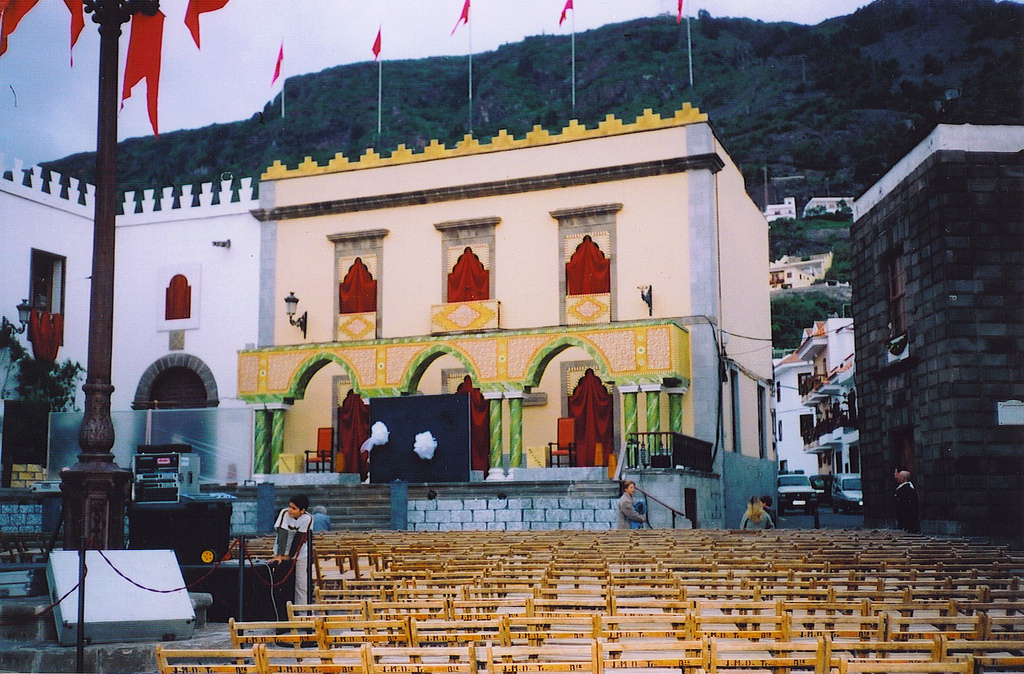
Their Cabalgata in Garachico, Tenerife, was slated to begin at 7 p.m. (yes, but where the "caravan" began, on foot, way up in the mountains) and carried on until well after midnight. (Get there early for parking though.) Accompanied by what seemed to be the whole town's youth, many dressed as Roman soldiers - carrying out their duties VERY seriously indeed - Their Majesties are received by Herod at the entrance to the town by the Castle, before making progress along the main streets and culminating in a Regal Pageant in the town square.

Garachico Town Hall doubles as the Kings' Palace

Fireworks crackled, drummers drummed (loudly), a fanfare resounded to announce the arrival of the cavalcade ... As horses and camels speed into the arena - real close between the seating laid out for the audience!

After a live re-enactment of the entire Christmas Story, complete with real live donkey, goats, sheep and even a human baby ... (with all the amusement you'd expect from such unpredictable participants, just like any school nativity play, and only adds to the cuteness), the Kings address the crowd from the palace Town Hall balcony, then take their thrones to begin dishing out gifts to a long list of kids, not just from Garachico, but from all over the island and even abroad. 

In recent years there has been a change in the format of these events: the use of animals is mostly discontinued to prevent their exploitation, as was the distribution of gifts publicly, so that "all the children can participate on equal terms".

Before that, local children put on a delightful show and, just to make sure this doesn't become an entirely spoilt "commercial venture", a film reminds us all of less fortunate kids in Africa, Asia, South America and other parts of the world. Us (so-called) grown-ups were way too tired to hang around right to the very end.

The scene is set outside the Church of Los Angeles

Traditional to eat on January 6, is Roscón de Reyes, a "crown" or ring-shaped bread, decorated with "jewels" of glacé fruits, which contains surprise gifts and a supposedly unlucky bean somewhere inside.

The year's second largest Lottery, El Niño, is also drawn on this day. This creates a bit of excitement in the Canary Islands, because, historically, this has dropped more decent prizes on the islands than the Christmas draw.

With Epiphany being on January 6th, it seems that Spanish Christmas holidays go on forever, but this is THE BIG DAY when everyone will have time off to be with their family. Many in the tourist sector worked on Christmas Day.

Santa Claus, better known here as Papa Noel, has gained popularity in Spain, appearing alongside Los Reyes Magos and he may bring a few presents on Christmas Eve - the justification is that it gives the kids more time to enjoy their new toys whilst they still have school holidays to amuse themselves in. The custom in families on the 6th is you get taken around to see what everyone got (with adults naturally feigning much surprise), which is great because you get to play with everyone's toys! Now I must go and get some straw ...