The most detailed English language website on the island

Weather - Tutiempo.net
     

After more than 20 years, posts here will now only be occasional (see why) for big events such as Tenerife Carnaval, so please "Like" and follow our Facebook Page to get future updates.

Showing posts with label Vilaflor de Chasna. Show all posts

Thursday, 22 September 2022

Almond Gathering and the Almond Fair

Almendras / Almond fruits

Many are familiar with the Rutas de Almendros en Flor (Almond Blossom Routes) in Spring, but at the other end of the season, in Autumn, naturally, follows the Recogida de la almendra (Almond Gathering), or Almond Harvest. 

It is tradition that, on the last Sunday of September, the residents of Vilaflor go out to collect almonds along a route of about five kilometres. The collected almonds are sold the following month at the Feria de la Almendra (Almond Fair), known as La Gran Majada, in Aripe in the municipality of Guía de Isora.

In Guía de Isora, a rural hamlet awaits you, located in the upper area of ​​the municipality, just a few kilometres from the town centre of Guía, where its Guanche origins and deep-rooted traditional customs make time seem to have stopped: Aripe. Declared an Asset of Cultural Interest, it has managed to preserve its rich natural and architectural heritage, offering landscapes of special beauty, which show us a perfect harmony between man and nature.

The picturesque and very traditional rural hamlet of Aripe is linked to three main roads: the Camino Viejo, a traditional link between the nearby hamlet of Chirche and Guía, and where the pilgrimage that took the Virgen de la Luz to the north of the island; the Camino Nuevo, built at the beginning of the 20th century, which led to Las Cañadas in the Teide National Park, around which new buildings were built; and the Camino de San Pedro, which led to Chiguergue.

Here you can find the Aripe engravings, which form the first sample of rock art dated on the island, where you will also enjoy the serene beauty of nature, which houses within it an important and charming architectural heritage, typical of the farm work: traditional houses, built in the 18th and 19th centuries, some converted today into picturesque rural lodgings; a series of constructions for agricultural use, such as threshing floors, ponds and tile and bread ovens; also a series of natural caves used for storage; all this in an agrarian landscape of small terraces, reflecting its traditional rural lifestyle and a very unique system of land use.

Its history is very similar to that of the neighbouring village of Chirche. Despite its Guanche origins, it is considered to be the 17th century when it developed as a population centre, first with livestock, later linked to agricultural production, mainly cereals and almond trees, during the 18th century, which achieved a significant increase in the population, which unfortunately entered into crisis in the second half of the same century. But that left a palpable sample of this agricultural tradition, reflected not only in its surroundings but also in the festivals that are celebrated, such as the popular Almond Fair. 

At the Almond Fair you will be able to transport yourself to the past, being a front-line witness of the artisan harvesting of the almond, through staging carried out by the locals, who are dressed in typical costumes of the time and provided with the utensils that were originally used for this task. This festival is celebrated around the end of October, although it does not have a specific date.

And after enjoying this beautiful and traditional festival, you can also buy a wide variety of products from the artisans of the municipality that have almonds as one of their main ingredients. In addition, at any time of the year, you can also buy honey and exquisite liqueurs, typical of the region.
Wednesday, 17 August 2022

The strange crime of Vilaflor

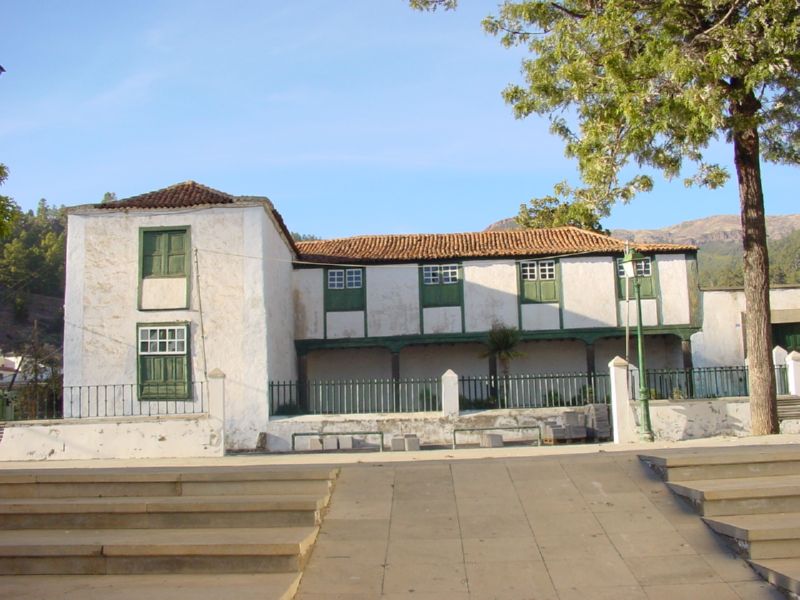
Casa de los Soler in Vilaflor

At sunset on August 17, 1840, when he was heading down the road from Granadilla to Vilaflor, near the small hamlet of Cruz de Juan Bello, just over a kilometre from the town, Don Alonso Chirino del Hoyo-Solórzano, VII Marquis de la Fuente de Las Palmas, was assassinated by twelve masked men. 

Nobody admitted it and the case is unsolved. Subsequent investigations failed to find anything out about that case and the file was dismissed. A thick veil of silence was spread over the entire region and not a single word came out of the mouths of the local people. You only heard them comment: "They say they killed the Marquis?" And the invariable answer was: "So they say."

We know the face of this noble from a portrait made of him by the Puerto de la Cruz painter Luis de la Cruz in 1815. In it he appears when he had just turned twenty-three years old, in a black frock coat, white vest, shirt and collar. The dark and deep eyes, the straight nose and the thick lips stand out in his face, distilling the image of him as aristocratic arrogance. When he died he was 48 years old.

To understand the causes of his death, we must go back to the 15th century. 

The region of Chasna belonged in pre-Hispanic times to the Menceyato de Abona (Menceyato was the name given to Guanche kingdoms) and when the island was conquered, the lands and the use of the waters became the property of Pedro Soler, a Catalan from Tarragona, who created a sugar mill and founded the town of Vilaflor or Chasna. In 1601, his grandson established a mayorazgo (a privilege allowing an individual to entail his estate so that his property, real or personal, could be passed on intact to a successor), from his lands that today form a large part of the municipalities of Arona, San Miguel and Vilaflor.

In the Plaza de San Pedro, in front of the church, stands the manor house of said mayorazgo, in which its gallery on stone columns stands out. Further down in the ravine, a water mill also owned by the Solers survives, although not in use. Then president of the Cabildo de Tenerife, Ricardo Mechior, expressed during a visit in 2004 his desire for this institution to buy and restore the Casa de los Soler.

From the beginning, the relations between this family and the locals were not good. The abusive model of leasing in kind without a contract allowed landlords to evict tenants, who found themselves in times of drought, condemned to starvation and emigration. The attitude of the owners of the mayorazgo provoked countless lawsuits and even popular uprisings against the family. In fact, the people of Chasna spent almost two hundred years without paying the fee for the usufruct - the right to enjoy the use and advantages - of the land and water.

Over time, the mayorazgo passed into the hands of the Chirino Soler family and in 1825, when Alonso Chirino inherited the marquisate from his father, he wanted to recover it by claiming the rights to the lands that had been cultivated by the peasants since time immemorial. A judgment of 1833 found in his favour and when it was ratified in 1840, the murder took place.

There were no reports and it was not known who the perpetrators were. This species of Tenerife social conflict between a feudal lord and his vassals has traditionally been considered as an example of the free and proud character of the people of Chasna in the fight for their rights, but for the historian Nelson Díaz Frías, author of the Historia de Vilaflor de Chasna, the murderers were the representatives of the rural Chasna oligarchy or mafia, which was clearly the most affected by the restoration of the mayorazgo. Even today, if you talk to the older people of Vilaflor and the issue of the murder of the Marquis de la Fuente de Las Palmas comes up, don't be surprised if they say: "They say they killed the Marquis." Nor are they surprised if you answer: "That's what they say." 

Monday, 21 March 2022

Anniversary of Saint Hermano Pedro

Iglesia de San Pedro Apostol (Church of St Peter the Apostle) in Vilaflor, Tenerife

Today is the anniversary of the birth of Hermano Pedro, the first Central American and Canarian Saint. Peter of Saint Joseph de Betancur (or Betancourt) y Gonzáles who was born in Vilaflor on 21st March 1626 and lived in Tenerife until the age of 23, dedicating his life to shepherding goats between the peaks and the coast, to his Cave of Santo Hermano Pedro. 

In the last half of his life, he lived in La Antigua, Guatemala, where he became a missionary. Through his charitable works, Brother Peter became one of the pioneers of providing medial assistance to convalescents as well as bringing education to the indigenous population and the poor. His dedication and work in providing for the most needy made him a popular figure amongst Christians in Guatemala, resulting in his canonization by Pope John Paul II in 2002.

Sunday, 1 August 2021

Town Hall & Fiestas in Vilaflor de Chasna

The Ayuntamiento (Town Hall) of Vilaflor de Chasna

Ayuntamiento de Vilaflor de Chasna, Plaza Dr. Perez Caceres, 1, 38613 Vilaflor, Santa Cruz de Tenerife. Phone: +34 922 70 90 02. Website | Facebook.

Fiestas in Vilaflor de Chasna include: 
  • Hermano San Pedro: 25 April
  • Corpus Christi: June
  • San Juan: 24 June
  • Romería de Ifonche: last week of June.
  • Santiago Apóstol: 25 July in La Escalona. Craft Fair.
  • Fiesta Mayor of San Roque and San Agustín: last week of August. Romería in honour of these two saints, patrons of Vilaflor. Craft Fair.
  • Ntra. Sra. del Pilar: 12 October in of La Escalona
  • San Andrés: 30 November
  • Ntra. Sra. Inmaculada Concepción: 8 December

Weather in Vilaflor de Chasna
Weather - Tutiempo.net