The most detailed English language website on the island

Weather - Tutiempo.net
     

After more than 20 years, posts here will now only be occasional (see why) for big events such as Tenerife Carnaval, so please "Like" and follow our Facebook Page to get future updates.

Showing posts with label Nelson's Attack on Santa Cruz 25 Jul 1797. Show all posts

Thursday, 22 July 2021

Chronology of the failed British assault on Santa Cruz de Tenerife of July 25, 1797

Information panel showing the Chronology of the assault of July 25, 1797
at the San Cristóbal Castle Interpretation Centre in Santa Cruz de Tenerife

In the spring of 1797, two English frigates boarded a Spanish frigate and a French corvette in Santa Cruz bay and, taking advantage of the darkness, took them out of the bay with little resistance. This action made Rear Admiral Horatio Nelson think that it would be easy to take over the port of Santa Cruz, and he proposed to Admiral Jervis an ambitious plan to prevent Spain from continuing to use the Canarian ports of call between America and Africa. On July 15, the English would abandon the blockade of the port of Cádiz and headed for Tenerife.

JULY 21

At dawn, the lookout at the Igueste watchtower spotted a British fleet on the horizon, made up of four ships of the line, three frigates, a cutter and a bomb vessel, communicating it to the Castillo de San Cristóbal by means of bonfires. In total 2,000 marines came and their ships carried 393 guns.

Once the alarm was sounded, General Gutiérrez, General Commander of the Canary Islands, brought together his staff and put the plan into operation; that is, to vacate the public offices of the Treasury, Tobacco, Post Office, commercial warehouses, and for women, the elderly and children to go up to La Laguna in search of refuge.

1,000 men from the Canarian Militia Regiments of Abona, Güimar, La Laguna, La Orotava and Garachico arrived in Santa Cruz, who would join the 600 soldiers of the Canary Islands Infantry Battalion; the 387 artillerymen defending the castles and batteries with its 89 guns; the 60 men of the Cuban and Havana Flags, the 110 sailors of the French corvette La Mutine, the pilots and sailors of the merchant ships stationed in the bay, and the volunteer countrymen.

JULY 22

At dawn, 23 boats full of Englishmen tried to land on Bufadero beach, but the assault was aborted thanks to a peasant woman from San Andrés who was going to the market to sell her wares and alerted the soldiers of the Paso Alto castle. At ten o'clock in the morning, three English frigates approached the Valleseco beach, and 1,200 men disembarked and seized the Mesa del Ramonal. Quickly, a detachment commanded by the Marquis de la Fuente de las Palmas occupied the height of Paso Alto, placing itself in front of the enemy.

At dusk, 300 men from the Infantry battalion, plus 50 Rozadores de La Laguna (volunteer countrymen who used rozaderas - sickles / farm implements - as weapons), prevented the English troops from advancing through those places.

During the night 500 militiamen joined, led by the mayor of Taganana, Andrés Perdomo Álvarez. At the same time, the English forces, taking advantage of the darkness, began the descent towards the beach and returned to their ships.

JULY 23-24

At three in the afternoon, the enemy squad set out to sea and headed southeast, losing sight of the height of Barranco Hondo. Despite the apparent withdrawal, during the night, at the suggestion of Lieutenant Francisco Grandy Giraud, a cannon - El Tigre - was placed in a new opening in the Santo Domingo bastion, in order to cover the Alameda beach that was located unguarded. At six in the morning of the 24th, the British squad appeared again off Santa Cruz, anchoring off Valleseco. At nine o'clock it was joined by a new 50-gun ship, of which the attacking force already has nine units.

Nelson gathered his officers on the flagship, HMS Theseus, to study the strategy they would carry out to take Santa Cruz. Such was his faith in victory that he even decided to take part in the attack, leading the landing force.

At seven in the afternoon, a frigate and a bomb vessel approached the coast and began to bombard the castle of Paso Alto, dropping a total of 43 bombs that did not cause appreciable damage. To this action, the fort responded with the fire of its pieces. 

JULY 25

In the early morning, the British landing craft are divided into several groups. The one that went to the dock and the Castillo San Cristóbal split in two. One of them, commanded by Captain Troubridge, managed to reach the dock stairs and disabled the seven guns in its battery. Then they tried to reach the castle but, when they were rejected, they made a detour and hid in the upper part of the Plaza de la Pila (Plaza de la Candelaria) where, at four in the morning, when they were discovered by the soldiers of the Canary Islands Battalion, they fled and took refuge in the Santo Domingo convent, now the Centro de Arte La Recova (Recova Art Centre) and Guimerá Theater.

However, the second group of boats, in which Admiral Nelson was approaching, could not achieve it due to the strong waves, going to beach their keels at the Alameda beach. When Nelson prepared to jump ashore and drew his sword to encourage the men he was hit by shrapnel from the Tigre cannon. Nelson's launch would return to the flagship, where his right arm was amputated at his shoulder. The cutter, Fox, which was escorting the aforementioned boats, was hit below the waterline and, amid a terrifying fire, sank into the bay with its 300 sailors, gunpowder and assault material.

Another group of boats, commanded by Samuel Hood, managed to land on the Carnicería beach and climbed the Santos ravine, until they were also protected in the Dominican convent.

At dawn, from the bell tower of the convent, they began to send signals to their boats asking for help, at the same time that they ordered General Gutiérrez to hand over the plaza, under the threat of setting the town on fire, to which Gutiérrez turned a deaf ear. Meanwhile, Lieutenant Grandy had returned to service the dock battery; so that, an hour later, when 15 boats full of English sailors headed there, with the intention of helping the companions who were in the convent, the cannons opened fire on them, sinking several boats, so who returned to their ships. At seven in the morning, when discouragement spread in the English troops, they asked to parley; For this, Commander Samuel Hood was led blindfolded to the castle of San Cristóbal, where he still dared to demand that General Gutiérrez surrender; he agreed to capitulate to the firm reply received: "There are still men and gunpowder left in the plaza for its defense." Immediately, a boat with Samuel Hood and Carlos Adán, captain of the sea (port pilot), went to the British flagship, where Nelson is informed of the conditions of the capitulation, to which he agreed and signed with his left hand.

JULY 26

At nine o'clock in the morning, in the Plaza de la Candelaria, bread, fruit and wine were distributed to the defeated British, and were then transferred to their ships in the boats of the Santa Cruz fishermen or in their own boats that had been left intact. The following day the wounded who had been treated at the two hospitals in Santa Cruz would be re-embarked. Nelson, impressed by such a kind act of chivalry of the Tenerife people, addressed a letter to General Gutiérrez - signed with his left hand - in which he expressed his gratitude for such deference, at the same time that he became the messenger of his own defeat. In gratitude, he gave him night vision glasses, a cheese and a barrel of English beer, to which Gutiérrez corresponded with another letter and gave him two limetones (demijohn) of local wine. The people of Santa Cruz could not imagine what that victory would mean for the future of his modest town. Four days later, the Mayor Real met the authorities and residents of the Place and Port in the church of Pilar, agreeing to designate copatrons to the Santa Cruz (Holy Cross) and the Apostle Santiago (Saint James), on whose day the triumph over the English had been consummated.

General Gutiérrez brought the matter to the court and, six years later, on August 28, 1803, King Carlos IV (Charles IV of Spain) granted the privilege of Villazgo (city status), added the qualifier of Noble, and granted the city its own coat of arms. Since then, it would be renamed: Muy Leal, Noble e Invicta Villa, Puerto y Plaza de Santa Cruz de Santiago de Tenerife (Very Loyal, Noble and Invicta Villa, Port and Plaza de Santa Cruz de Santiago de Tenerife).

* Official chronicler of Santa Cruz de Tenerife 

Cronología de la Gesta del 25 de julio de 1797

Re-enactment of the La Gesta Batalla.

Tuesday, 20 April 2021

Military Museum, Santa Cruz de Tenerife

Museo Histórico Militar de Canarias in the Fuerte de Almeyda 
Image: CARLOS TEIXIDOR CADENAS, CC BY-SA 3.0

Of course that's what parking spaces are for!

Model ship. To be fair, not everything has an English label.

Cannon "El Gato" (The Cat)

This one's called "El Miserable". Wouldn't you be, if it hit you?

The flag of the British frigate, "Emerald", it is said, was found at dawn on 25 July 1797,
in one of the [British] launches tied up on the coast of Santa Cruz.

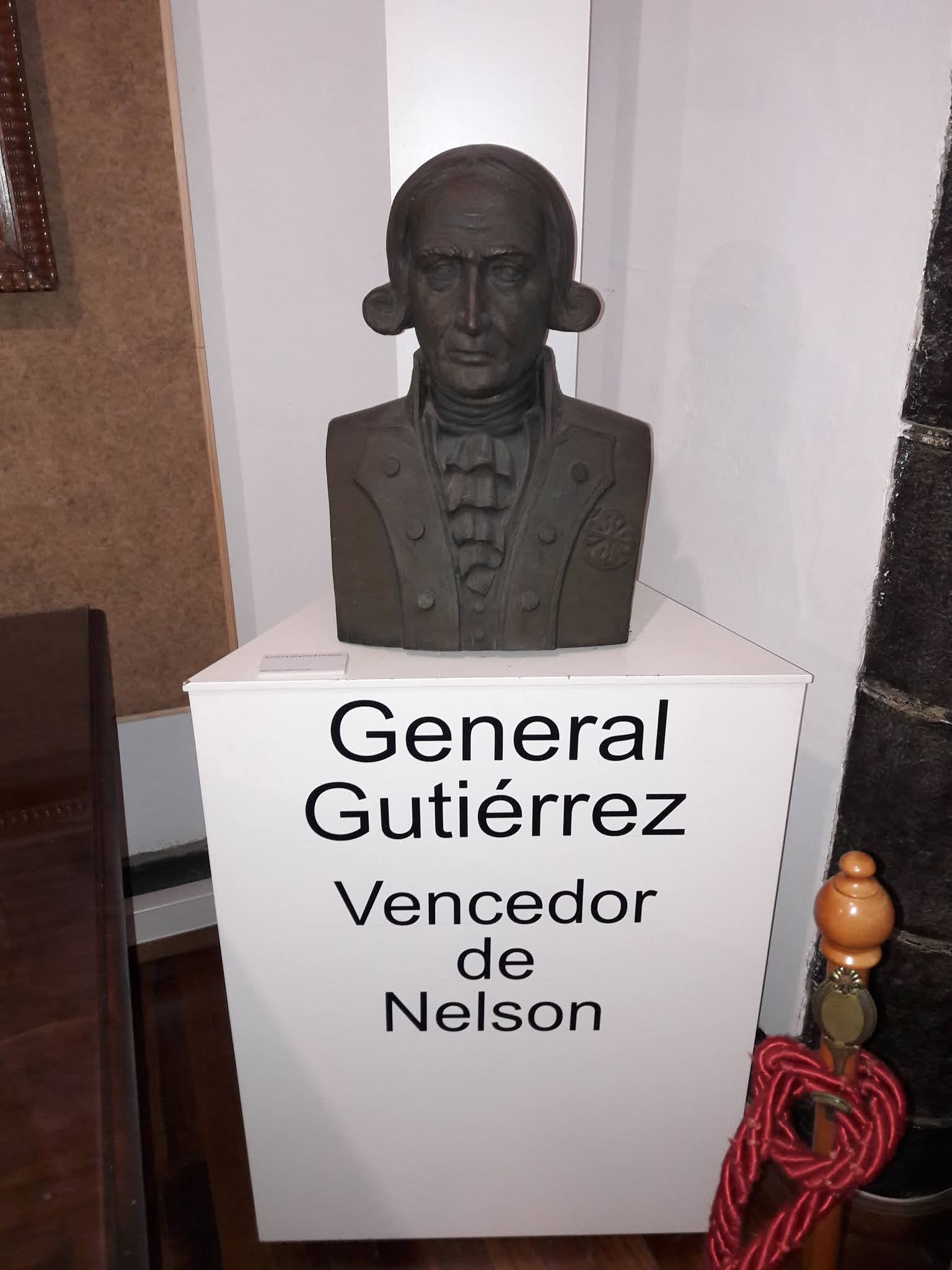
General Gutiérrez Trouncer of Nelson


Interior of the curved courtyard


Scale model depicting the Battle of Santa Cruz 1797


Tuesday, 23 April 2019

Plaza de los Patos, Santa Cruz de Tenerife

Frog on the fountain, Plaza de los Patos, Santa Cruz de Tenerife

The famous Plaza de los Patos (Ducks Square), in the so-called Barrio de los Hoteles (Hotels District), described as the Sweetest Square in Santa Cruz merits a visit. It's real name is the Plaza de 25 de Julio, so named after the failed attack on Santa Cruz on that date in 1797 by Admiral Horatio Nelson.


La reforma de la Plaza de los Patos

The plaza, built between 1913 and 1917, a symbol of Santa Cruz and an important part of the city's heritage, was reopened after refurbishment last year. The fountain has figures of eight frogs that surround the central goose. The most outstanding feature of the square, in addition to the central fountain, are the 20 benches, covered in ceramic tiles from Triana (Seville), bearing the names the companies who sponsored the construction of the Plaza.

Plaza de los Patos in 1920 [Public domain], via Wikimedia Commons

From here, it's well worth taking a stroll north on the Avenida de Veinticinco de Julio (25th July Avenue - there's a bit of a theme here - to where the avenue crosses the Rambla de Santa Cruz at the corner of the Parque García Sanabria and stop at the Kiosco Numancia. Apparently, it has a reputation for being expensive (we didn't notice), but has such an interesting position right in the middle of the street where you can watch the world pass by on either side, with the tranquillity of the park next to it. A perfect coffee stop in a city.

Central goose in the central fountain

The central fountain clad in the tiles from Tiriana (Seveille)

Bench with advertising for one of the plaza's sponsors

Another sponsor's bench for Three Steamers Safety Matches

Bench advertising sponsor, Suchard Chocolate


Plaza de los Patos - Santa Cruz de Tenerife

Tuesday, 9 April 2019

San Cristóbal Castle Santa Cruz de Tenerife

Cañón Tigre - decisive in the defeat of English Admiral Horatio Nelson in his attempt to invade Tenerife in 1797 - currently on display in the San Cristóbal Castle interpretation centre.

Underneath the Plaza de España in Santa Cruz and marked by the black lines that can be seen in the lake from above, are the ruins of the Castillo de San Cristóbal (Castle of San Cristóbal). Portions of the castle ruins were uncovered during the refurbishment of the plaza carried out by the Swiss architects Herzog & de Meuron in 2006 and these ruins are now open to the public via The San Cristóbal Castle Interpretation Centre. Reading that the centre was to be closed during carnival, we made this our first port of call after we arrived in the city.

Entrance is FREE, so it's well worth it to have a look if you're in the city and for those of a nervous disposition, I'll just mention that the steps are quite normal and the well-lit underground exhibit is not at all dark and dingy as I was expecting.

You don't need to be in Santa Cruz de Tenerife long before you realise that 25 July is a very important date! The whole centre is nicely done with information on various historical attacks on the city - not just the English ones, although that one always figures strongly in any history of the city and here is no exception - with good English translations under the information panels.

At the end of the 1990s, Santa Cruz de Tenerife still had not resolved the integration of the port into its urban core, a situation that led to the calling of several tenders. The Cabildo, the City Council and the Port Authority finally opted for the Herzog & De Meuron project, one premise of which was that the citizen, taking Calle del Castillo as a starting point, could move towards the waters of the Atlantic Ocean, following a longitudinal path in the manner of a previous project proposed by José Blasco Robles and José Luis Escario, which linked two existing squares – Candelaria and España – and a newly created one, the “Plaza del Agua”. In short, it was an ambitious staging that fused the metaphor of the gateway to the Atlantic with the protection of visible architectural vestiges, such as the Monument to the Fallen and the façade of the Alameda del Duque de Santa Elena, as well as other equally known but disappeared ones, such was the case of the Castillo de San Cristóbal. Some remains of its original walls appeared again during the remodelling works of the space and were incorporated under the surface of the recently created "Plaza del Agua". To access the find, a structure of galleries was set up to facilitate access to the venerable vestiges, a space that required the implementation of an interpretation centre. 

In this way, the San Cristóbal Castle Interpretation Centre was conceived, inaugurated in July 2008 and managed by the Autonomous Organism of Museums and Centres of the Cabildo de Tenerife through the Museum of History and Anthropology. The status of interpretation centre has eclipsed, to a certain extent, the nature of a site museum – the first in Tenerife – of the Castillo de San Cristóbal. Indeed, the aforementioned space offers citizens the possibility of visiting one of the most powerful heritage remains that have shaped its history, defending the island for more than two centuries against naval attacks.

In addition to the walls, the San Cristóbal Castle Interpretation Centre offers the possibility of contemplating other exhibits, such as the two tombstones that recall the name of the person who was the builder of the main fortress on the island of Tenerife, Juan Álvarez de Fonseca; and, of course, the presence of the “El Tigre” cannon, exhibited for the first time since it was put out of service, in the environment where it once played a more than outstanding role in the early hours of July 24 to 25, 1797, as evidenced by the testimonies of Monteverde and Grandi Giraud, protagonists and exceptional witnesses of the events.

From the very moment of the centre's inauguration, Tenerife Museums always had the suspicion that it would waste the museum space if it focused exclusively on the Gesta of July 25, an episode whose dimension and appeal have made us overlook the three previous centuries of history of the castle and, by extension, of the city. That is why it was proposed as a place for reflection on the history of Santa Cruz de Tenerife, conceived from the present to the past, taking into account the importance of the fortifications, but also in other episodes that date back at the time of the conquest. Since its inauguration, the San Cristóbal Castle Interpretation Centre has remained open to date, becoming a benchmark for citizens, both local and visitors. 


Restos del Castillo de San Cristóbal - Enrique Castrillo Núñez [CC BY-SA 2.5 es]

Wednesday, 23 July 2008

Santa Cruz set to repel the English, again

Castillo de San Juan Bautista (Castillo Negro)

Friday, 25th July 2008 is the 211th Anniversary of Santa Cruz' historic defeat of Horacio Nelson and Tenerife's capital is to commemorate the date with a re-enactment (now annual) of the Battle of Santa Cruz de Tenerife (1797) ... and have a budget of 240,000 euros (over £190,000) available to do it.

The fun starts, in the area of the Castle of St John the Baptist a.k.a. Castillo Negro (Black Castle) (alongside the modern day Auditorio de Tenerife), at 12.00 mid-day and, unlike real battles, will last for just one hour. Some 130 people are taking part in the re-enactment, with the city being defended, once again, by the battalion of Canarian infantry, under the orders of General Gutiérrez.

British retreat and victory for Santa Cruz

The following day, Saturday, 26th July, at 11.30 a.m., sees a military parade from the Plaza Weyler to the Plaza de España, then from 8.30 p.m. there's to be a further recreation, in the streets of the old town, remembering how Santa Cruz' population succeeded in causing the English troops to retreat. That will be taking place in the area around the bridge over the Barranco de Santos, the Iglesia de La Concepción (church) and the Calle La Noria in the old part of the city.

Both re-enactments are to be directed by Teodoro Ríos, who will ensure careful attention is paid to historical detail. Costumes are under the watchful eye of José Carlos Iribarren, who worked on the film Alatriste and, the special effects (as well as the fireworks during the Verbena de La Victoria (Victory Celebration Dance)) will be provided by Los Realejos firework firm, Hermanos Toste.

In addition, 75 re-enacters have been invited from various points of the Spanish mainland, from England and from Holland.

An entire festive week ...

On July 21st, in the Museo Militar de Almeida (the museum's highlight is was the famous 'Tigre' canon which, according to (erroneous) tradition, injured Admiral Horacio Nelson during his failed attempt to occupy Tenerife on July 25th 1797, resulting in the amputation of his right arm, was the presentation of a new book and a conference on the events of 1797.

On July 22nd, again in the Military Museum, is another conference, centring on the personalities involved on July 25th, along with a presentation of a new book by local historian Daniel García Pulido, as well as a showing of the rather ominously titled film, La isla de las cabezas cortadas (Cutthroat Island.)

On July 23rd, it's the turn of historian, Ronald Brighouse to give a talk centred on Nelson and the Royal Navy. Another film follows.

On July 24th, from 10 a.m. will be a public reading of books related to the events. In the evening, the British flag captured that night in 1797 will be (re)presented, having been restored.

On July 25th after the re-enactment of the sea battle and the English landings at midday, at 7.30 p.m., mass will be celebrated in the La Concepción church, with a procession around the local streets in honour of Santiago Apóstol (Saint James) and a floral offering made to the tomb of General Gutiérrez.

Also on July 25th there's an exhibition of reproductions of paintings that recreate these events, as well as some military paraphernalia that is part of the municipal heritage. They're also studying the possibility of installing 14 commemorative milestones along the capital's coast. These monoliths, with their corresponding plaques would be placed at strategic points where the defence of the city was cemented (and they're outside the 240k budget.)

The town hall is to award silver medals to all babies born on Friday, 25 July.

July 26th 11.30 a.m. military parade "of the epoch" (another recreation of the 18th Century) from the Plaza Weyler to the Plaza de España. At 7 p.m. various military bands will parade through the city's streets. From 8.30 p.m. will be the recreation of the street battles in the old part of town and, from 10 p.m., the party starts proper, with a Verbena de La Victoria (Victory Celebration Knees Up), at which attendees will wear 18th Century costumes.

And, finally, on July 27th, the festive week (their words) closes with a concert by the Unidad de Música de la Subinspección del Mando de Canarias (a military band), in the Plaza del Príncipe (where you can get a good Barraquito.)

Via: this post at the Flickers Tenerife group.

Wednesday, 26 July 2006

Santa Cruz, Once Again, Celebrates Victory Over The English Admiral, Horacio Nelson

Horatio Nelson wounded at Tenerife
The Tenerife capital yesterday celebrated the 209th Anniversary of its famous and proud victory over English Admiral, Horacio Nelson, whose failed attempt on Santa Cruz, on July 25th, 1797, cost him his right arm. Among the events to commemorate this important date in the city's history was a mass in the church of La Concepción, a procession around the area of the Calle de la Noria and an offering at the statue of General Antonio Gutiérrez, who led the troops that defeated the British Navy.

Historian, Daniel García Pulido, member of the "Association of Friends of July 25th", also announced that the group has been asked to collaborate in an investigation over the whereabouts of the wreck of the British ship, the cutter Fox, which was sunk off Santa Cruz during the battle. According to this report, Fox was carrying a reserve store of arms and ammunition and went down with 180 men, 97 of whom were lost. The remains of the ship lie between Paso Alto and the Plaza de España. A private initiative aims to discover the exact whereabouts.

Another of the questions which the group has been studying is over the number of British losses during the battle. The number that the Canarian troops had boasted was 800, nevertheless, the historians have so far confirmed, after combing the records, that the true number was 124.

Asked what would have happened if the Tenerife troops had not defeated Nelson, García Pulido responded that two theories exist. "Thanks to documentation, we know that Nelson wanted to stay in Tenerife and use it as an exchange." While British history claims that the admiral's only intention was to destroy the ships, loaded with a large quantity of gold and silver, which were anchored in the port of Santa Cruz and would have bankrupted Spain.

Two aspects of the battle are certain: one, the capital increased its prestige after this development. The other: that there is much still to study and resolve.

Monday, 25 July 2005

Nelson's Failed Attempt on Santa Cruz

Ataque británico en Santa Cruz de Tenerife

Jul 25, 1797 – British naval commander Horatio Nelson's right elbow is shattered by grapeshot during an assault on Tenerife; the arm had to be amputated. After the English requested terms of surrender, "Don Antonio Gutierrez, the Commandant General of The Canary Islands acted as a gentlemen and, with great generosity, accepted these terms. It went further than this; the Spanish helped to ferry British wounded back to their ships and invited the officers to dine with them that evening." But, don't go thinking that they kissed and made up and promptly forgot all about it! The city of Santa Cruz takes great pride in displaying the gun with which the famous arm was reputedly shot. Also ...
"It was claimed that Nelson's arm was kept behind the altar in the Cathedral in Las Palmas, Gran Canaria. So far as I know no-one has refuted this. Anyone going on holiday to Gran Canaria might want to check out if it's still there. It would be one hell of a holiday souvenir."
Whilst the above claim is unlikely, if you visit Tenerife (not Gran Canaria) you will find many real souvenirs from the battle. Paintings depicting the battle can be found in the collections of the Municipal Museum of Fine Arts and the Regional Military Museum. The heraldic arms of the City, Port & Square of Santa Cruz de Santiago de Tenerife has a green cross, symbol of the Foundation of the Cross, which gave name to the city. Behind the cross, in red, appears the Sword of Santiago (St. James, Spain's Patron Saint), on whose day it was the city trounced Horacio Nelson. Under this sword appear three lion's heads, which symbolize the victory of the city over the English pirates. July 25, 1496 is also the date of the end of the conquest of Tenerife by the Spanish. 

"El Brazo de Nelson" (Nelson's Arm) is also the name of a wargames club, Club of Games of Strategy and Modelling in Tenerife.