The most detailed English language website on the island

Weather - Tutiempo.net
     

After more than 20 years, posts here will now only be occasional (see why) for big events such as Tenerife Carnaval, so please "Like" and follow our Facebook Page to get future updates.

Showing posts with label Carnival History. Show all posts

Sunday, 22 February 2026

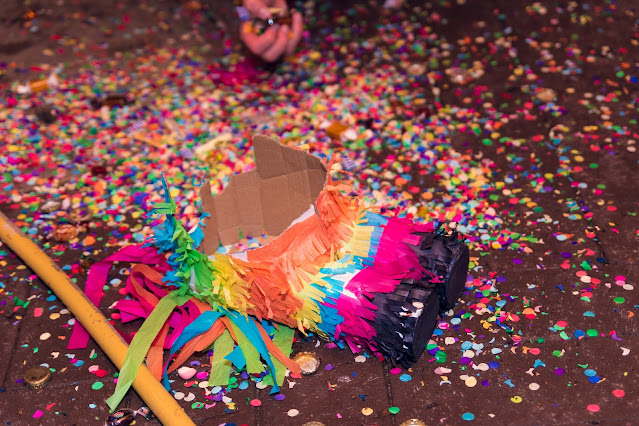
Why is the Last Weekend of Santa Cruz de Tenerife Carnival Called Piñata Weekend?

At Carnival on Piñata Saturday 2026

The term "Piñata Weekend" originates from an old custom that prolonged Carnival beyond Shrove Tuesday and Ash Wednesday, well into Lent.

Carnival officially ended on Ash Wednesday, and Santa Cruz already mourned during the Burial of the Sardine. But the festivities still have one last push with Piñata Weekend. After Carnival comes Lent, a time historically dedicated to reflection, from which these last two days of celebration are taken. But what is the origin of its name?

The term "Piñata Weekend" originates from an old custom that extended Carnival beyond Shrove Tuesday and Ash Wednesday. "In various parts of Spain and in the Canary Islands, the festivities continued during the first days of Lent, in what was known as Little Carnival or Piñata Carnival," explains Julio Torres, a historian from La Laguna, citing researcher Pedro Manuel Grimón González.

Italian Pignatta

The word comes from the Italian word pignatta (fragile pot), because it was traditional that before the start of Lent, a period of fasting and abstinence, the game of breaking a clay pot or pignatta filled with sweets was celebrated.

"The piñata resembled a large orange, covered in colourful fabrics and adorned with numerous colorful ribbons. One of these ribbons opened the mechanism through which the objects inside fell out: nuts, flour, candies, gofio (a type of flour), eggs, sweets, and perhaps a small mouse or rabbit."

Piñata Dance

The piñata was broken as part of a choreographed dance, the Piñata Dance: "Couples began to dance, circling the piñata. The leader kept order so that all the couples took turns pulling the ribbons. When the piñata broke, the music stopped."

Today, carnivals like the one in Santa Cruz de Tenerife maintain Piñata Saturday and Sunday as days of intense festive activity. These dates are located after the Burial of the Sardine and are part of the calendar that marks the end of the celebrations in the city, but the festivities continue in other parts of the island.

¿Por qué se llama Piñata al último fin de semana del Carnaval?

(A pignatta (or pignata) is an Italian term for an earthenware cooking pot, historically used to cook beans in fireplaces. It is the origin of the Spanish word "piñata", referring to the fragile, clay containers used in European and, later, Mexican celebrations. It's derived from the Latin pinea ("pine cone"), referencing the original shape of these pots.)

Winter Olympics Carnival Style on Piñata Saturday in Santa Cruz 2026

Friday, 13 May 2022

Remembering Enrique González Bethencourt

Enrique González Bethencourt (September 23, 1924 - May 13, 2010) was the founder and director of the Afilarmónica NiFú-NiFá and is considered the father of the Canarian murgas. He was also one of the most important and beloved personalities of the Santa Cruz de Tenerife Carnival.

Third son of four brothers to a father from Cádiz, by profession he was a quantity surveyor. He was also trained in Fine Arts, exhibiting his pictorial work for the first time in July 1944, and created the poster for the 1992 Carnival. 

In the year 2000, González Bethencourt was awarded the Knight's Cross of the Royal Order of Civil Merit. The same year, Santa Cruz de Tenerife City Council named a street after its veteran murga, the Afilarmónica NiFú-NiFá. Such was the value of his work for the carnival that the 2011 edition was dedicated to him, in which the Queen's Gala became a posthumous tribute to his life and career. In addition, the poster for the Carnival of Santa Cruz de Tenerife 2011 was made by his daughter.

On May 13, 2013, on the third anniversary of his death, a statue was inaugurated in his honor located in the Plaza del Príncipe in Santa Cruz de Tenerife. 

Saturday, 5 March 2022

The origins of the Carnival Piñata

Piñata

In Tenerife, the last weekend of carnival and first weekend of Lent, is known as Piñata Weekend when supposedly pre-Lenten carnival festivities continue. 

Piñatas are a central element of birthdays and other festive celebration events. Children try to break them to enjoy the loot of candies and other gifts that are hidden inside. However, its origin is not related to children's entertainment. 

The piñata is associated with Latin culture, although historians point to Asia (particularly China) as its actual point of origin. The famous traveller Marco Polo, on his visit to that nation, is supposed to have seen how the Chinese created colourful figures of animals covered with paper, which were hung and used in New Year celebrations. Polo brought the idea of ​​those first piñatas to Europe.

Europeans linked the piñata with the celebrations of Lent. The first Sunday of that liturgical period became "Piñata Sunday", derived from the Italian term pignatta, whose meaning in Spanish is "fragile pot". The custom spread to nearby regions, where Lent acquired the celebration of "El Baile de la Piñata" (Piñata Ball), in which a clay vessel known as "la olla" was used to serve as a piñata. 

Rumours of such a tradition crossed the ocean and reached America. The Spanish missionaries took their piñatas with them, covering them with coloured paper, with the aim of attracting parishioners to their religious ceremonies. 

Eventually, the piñata acquired religious significance, as it was intended to represent Satan, who was credited with wearing attractive masks to induce people to become sinners. The piñata then took on a satellite shape: a sphere with seven protruding cones. These cones represented the seven deadly sins: greed, gluttony, sloth, pride, envy, anger, and lust. The candies inside were symbols of the temptations that wealth and earthly pleasures implied. 

The custom of breaking the piñata arose in Mexico. Blindfolded participants were ordered to hit the piñata in an effort to combat demonic forces. The club used to smash the piñata, symbolized virtue. Once the piñata was broken, its content was the prize to the participants for being faithful to their faith.

Slowly, the piñata lost its religious association, and today it is merely considered a symbol of fun and entertainment, although it retains its religious significance in some regions. It can be used during the holiday season or at birthday parties, and is no longer reserved for the Latino culture, as people of all nationalities and backgrounds take turns hitting the piñata.


The Baile de la Piñata (Piñata Ball) continues to be celebrated in Tenerife as the central event to the carnival festivities in the remote hamlet of Teno Alto.

Wednesday, 2 March 2022

Why do we bury a sardine on Ash Wednesday to say goodbye to the carnival?

The sardine to be cremated in Santa Cruz de Tenerife in 2019

For several days, costumes, dancing and revelry [usually] flooded the streets of half of Spain. However, on Ash Wednesday everything returns to normal after the Burial of the Sardine. But why do we bury this fish to say goodbye to Carnival?

The Burial of the Sardine consists of a carnival parade that parodies a funeral procession and ends with the burning of a sardine-shaped figure. It's usually celebrated on Ash Wednesday and serves to put an end to the madness of Carnival and usher in the seriousness of Lent. Popularized from the 18th century, as it is such an old tradition, there are various theories about its origin.

According to popular legend, the fault lies with a shipment of sardines in poor condition that arrived at the Madrid markets during the reign of Carlos III (Charles III of Spain). Such was the stench that the king, fearing for the health of his population, ordered the burial of all the rotten sardines on the banks of the Manzanares River. Convinced by this theory, today the Brotherhood of the Burial of the Sardine in Madrid ends its procession at La Fuente de los Pajaritos in the Casa del Campo, as it's said that the sardines were buried there. Other historians, on the other hand, relate the party to Jerónimo Grimaldi, one of the last ministers of Carlos III who was curiously nicknamed "the sardine" because of his extreme thinness. It's said that Grimaldi left the city of Madrid around Lent and the people of Madrid decided to bid him farewell with a great masquerade.

It seems clear that the tradition had its origin in the capital of Spain and spread to other cities in the country and even Latin America. Currently, one of the most massive and famous Burials of the Sardine is the one held in the city of Murcia. However, it has some peculiarities since, for example, it is not used to say goodbye to Carnival but as part of the Spring Festival after Holy Week. 

Sunday, 27 February 2022

The Trigger's Broom of Tenerife Carnival

The City Council presents the new sceptre of the Carnival queen

Santa Cruz de Tenerife City Council, through the Autonomous Organism for Festivities and Recreational Activities (OAFAR), presented this Wednesday the new sceptre of the Carnival queen. An exclusive creation for Santa Cruz carnivals that will replace the current one, which dates from the second half of the 1960s. The new piece made by jeweller Juan Gil, luthier David Sánchez and wood turner Rubén Expósito, is made up of various stones that have been part of the costumes of the Carnival queens between 1979 and 2020.

The act was presided over by the mayor of the city, José Manuel Bermúdez, who was accompanied by the Councillor for Fiestas, Alfonso Cabello; the director of the Carnival, Enrique Camacho; and the craftsman Juan Gil and his team.

In his intervention, the mayor recalled that "tonight the Queen's Gala would have taken place if we had respected the traditional dates of our Carnival before omicron appeared and to replace it, in a modest way, what we have done is present a new sceptre. Carnival is our sign of identity, it is a feeling that is deeply embedded in the hearts of our people. For me, one of the most beautiful things that there can be as a chicharrero is to deliver the sceptre to the queen of the Carnival”. "Linked to the Carnival is the largest associative movement that this city has, almost 10,000 people, who need their performances, so it is key that they can have an objective such as rehearsals and competitions," added Bermúdez.

The Councillor for Festivities, Alfonso Cabello, stated that "it is a privilege to be able to have an exclusive artisan element that will be delivered for the first time at the Election Gala to be held this June." According to the person in charge of OAFAR, "the sceptre perfectly represents the idiosyncrasy and the feeling of the Santa Cruz festival".

Juan Gil, creator of the new carnival baton, acknowledges that "from the first moment this piece has been a real challenge, in which I have tried to capture the Santa Cruz festive heritage, combining the brightness and illusion that this celebration exudes". He also referred to the "multidisciplinary work with the craftsmen David Sánchez and Rubén Expósito, essential to have made the creation of this unique piece possible".

The sceptre has a length of 42.3 cm and is formed in its upper part by an element reminiscent of the añepas, a symbol that represents the power of the Mencey (Guanche Kings). This element is made up of 7 pieces with 6 welds made of sterling silver with sheets between 0.7 and 1.2 mm thick. The central body is a cold fusion by casting high-density epoxy resin on an African Makassar ebony support that brings together the stones of the different carnival reigns. The lower part is made up of 5 pieces joined by 4 welds, also in sterling silver with 0.6 and 1.2 mm sheets that show a design inspired by the traditional Canarian ring. Both this section and the central body show a turning to the axis and another eccentric that allows you to achieve a transition from circular to oval section.

The costumes that have contributed an element of their precious stones to the new sceptre are: “Tangerine Dream” (1979) by Justo Gutiérrez and Leo Martínez; “Frivolous Paris” (1983) by Miguel Ángel Castilla; “Tajaraste” (1987), “Cleopatra, Queen of the Nile” (1988), “Miss Dior” (2007), “Bewitched” (2009), “In Wonderland” (2010), “One Hundred Years of History” (2011) by Leo Martínez; “Pim, pam, pum… fire” (1993), “Diva” (1994) and “Palabras Mágicas” (1995) by M&M; “Manila Yerichana” (2000) “Wednesday of the full moon” (2004), “Touching the skin of the sky” (2005) and “The Chariot of Glory” (2006) by Juan Carlos Armas; “Láchesis” (2003), “The Golden Age” (2008), “Empire” (2012), “Volare” (2013) by Santi Castro; “Powerful Amazon” (2014) and “White Sand of the Desert” (2016) by Daniel Pages; “Áurea” (2015), “Madame Soleil” (2017) and “Renacida” (2018) by Jorge González; “La Nuit” (2019) and “Sentir” (2020) by Sedomir.

El Ayuntamiento presenta el nuevo cetro de la reina del Carnaval (Via)

Lovely as it is (better picture here) - no detraction is intended and the symbolism and re-use of elements is inspired - HOWEVER, as there was no carnival and no new carnival queen in 2021, Santa Cruz instead elected three Guardians of the Sceptre at the virtual only gala. So as the sceptre that the Guardians of the Sceptre have been elected to guard until a new queen can be chosen in 2022, isn't the sceptre that will be presented to the new carnival queen in June, doesn't this (presumably accidental irony) make it into something of a Trigger's Broom Paradox (Ship of Theseus for the academics)?

Wednesday, 3 March 2021

Santa Cruz en Carnaval 1987

Carnival Queen Costume 'Tajaraste' from 1987, on display in the Casa del Carnaval

Carnival Poster 1987
Carnival in Santa Cruz de Tenerife in 1987 was a moment of crucial importance in the island's and the celebration's history for a variety of reasons. It was the first year that the carnival festivities had a theme, which in 1987 was Roma (Rome), for which the perimeter of the Plaza de España was encircled by a colonnade, evoking the Ionic style and giving it the appearance of a circular Roman temple. The lintels that joined each pair of columns was adorned with two chicharros (Atlantic horse mackerels), crowned with laurels.

Most of all, 1987 was the year that the carnival made history by getting into the Guinness Book of Records, with the dance on Shrove Tuesday becoming "the largest gathering of people in an outdoor plaza to attend a concert".

Carnival Queen in 1987 was Mónica Raquel Estévez Martín, then 16, in a costume entitled, 'Tajaraste', designed by Leo Martínez and inspired by the typical costume of Tenerife, representing Almacenes El Kilo.

Maids of Honour in 1987 were: 
  1. Irene Hernández Morales with a costume entitled, "Origen de luz" (Origin of light), representing Calzados "Romea", designed by José Julio Rodríguez  
  2. Elizabeth Suárez Santos with a costume entitled, "Así pasó el cometa Halley" (This is how Halley's comet passed), representing the Casa de Venezuela en Canarias and designed by Miguel Ángel Castilla Abreu 
  3. Sandra Lobenstein Recio with, "Cabañuelas de febrero" (February Cabañuelas), representing Casino Taoro, designed by Marcos Marrero 
  4. María Candelaria Díaz Álvarez with costume, "XTRO siete punto omega", representing Centro comercial Maya and designed by Justo Gutiérrez  
The senior carnival queen in 1987 was Alfonsa Rodríguez Fernández, with a costume entitled, 'Fantasía brasileña' (Brazilian Fantasy), representing the old folks home, Hogar del Pensionista Nº1 de S/C in Santa Cruz de Tenerife. 

Junior carnival queen in 1987 was María Guacimara Martín Peña with a costume entitled, 'Campanilla de los bosques' (Bell of the woods), designed by Pedro José Ortega and Juan de la Rosa and representing Almacenes Elle.


Video: Coronación Reina del Carnaval de S/C de Tenerife 1987

The Carnival Queen Gala took place in the Plaza de Toros (Santa Cruz Bullring). Further videos show the performances of the comparsas, Los Joroperos and Las Cariocas and a parade of all of the carnival personalities and vintage cars.

Carnival Queen in 1987, Mónica Estévez, was interviewed 31 years later in 2018 and said that she had grown up in the next street from where designer Leo Martínez was located, surrounded with carnival from a young age. She would go there to see the girls and the costumes and was always saying she wanted to present herself as a candidate ... repeatedly. It seems that Martínez agreed to present her, pretty much just to shut her up. She didn't ask anything about the costume and never saw it complete until three days before the gala.

Santa Cruz Carnival Dance 1987

The multitudinous dance that went down in history: Celia Cruz with the Sonora Matancera and Billo's Caracas Boys led the line up of an unforgettable Carnival Tuesday night in 1987 for the more than 240,000 attendees.

On March 3 1987, the dance on Carnival Tuesday put Santa Cruz de Tenerife into the Guinness Book of Records after gathering the astonishing number of people (240,000 was the number officially recorded by the notarial deed) dancing in the street to the songs of Celia Cruz with Sonora Matancera, Billo's Caracas Boys and Tenerife orchestras Maracaibo and Guayaba, in a show never before seen on the islands with 40,000 watts of sound and spectacular lighting. On the night of Monday to Tuesday of Carnival the last orchestra left the stage at 06.30 hours, but the audience, almost as numerous as at 11.00 at night, continued to dance to recorded music in the kiosks. Many partied on in various parts of the capital and others went to Las Teresitas to take a dip in the sea.


Video: Carnival Main Parade in Santa Cruz de Tenerife in 1987

Neither the heat nor the fatigue of the previous night prevented 200,000 people from concentrating to watch the cavalcade that began at 3:30 pm on the Tuesday afternoon. The number of spectators, facilitated by the Local Police, was significant, since the population of the city at that time was 210,000 inhabitants. Some 25,000 people participated in the parade, in addition to 119 groups, 20 floats and more than 100 decorated cars. The fireworks display finale was the prologue of the great dance. The City Council's intention was that this dance be the busiest in the world and with the Celia-Billo's duo, success was assured. Almost half the island of Tenerife met in Santa Cruz that Carnival Tuesday to experience an environment impossible to describe. The Plaza de España and Candelaria, the Alameda del Duque de Santa Elena, and all the surrounding streets, were full to bursting.

Celia Cruz in Tenerife in 1987

Celia Cruz was already a living legend when she came to Tenerife: Her powerful voice opened the doors to the whole world with songs like Bemba colorá, Usted abuso, Nadie se salva de la rumba, Que le den candela, La vida es un carnaval… Until her death in 2003, Celia was the best ambassador of Tenerife's carnival. Her connection with the island became so strong that she confessed that she calmed her longing for Cuba among the islanders, and performed in a trance-like state, as if she had returned to her native island.

Celia passed like a whirlwind through Tenerife. She arrived on the island on February 27 and the Cuban Association of the Island was waiting for her at the South airport. Staying at the Hotel Botánico, Celia and her inseparable Pedro Knight, enjoyed the parade on Friday from the Town Hall, receiving the love and recognition of the carnival groups that noticed her presence. Thousands of people gave her a standing ovation at the two previous concerts held in the Plaza de Toros (Santa Cruz Bullring), and she continued in ecstasy singing Bemba colorá for 20 minutes. That double success attracted more anticipation for the performance of Carnival Tuesday. The queen of salsa continued in a trance and dedicated to the audience the Pasodoble Islas Canarias a cappella in one of the most memorable moments of an unbeatable Carnival.

El multitudinario baile que pasó a la historia con Celia Cruz

Monday, 24 February 2020

Afilarmónica Ni Fú-Ni Fá the grandfathers of carnival in Santa Cruz de Tenerife

The Afilarmónica Nifú Nifá at the head of the Carnival Parade on Tuesday 5 March 2019

The Afilarmónica Nifú Nifá (fondly known as La Fufa) is a carnival institution. Whilst the order of queens and the various groups in the parades is determined by their placing in the various contests in the run up to carnival in the street, La Fufa always head up the parades, owing to their position of seniority.

History of the Afilarmónica Nifú Nifá

In 1917 a chirigota from Cádiz participated in the carnival of Santa Cruz de Tenerife for the first time. They were sailors from the gunboat “Laya” of the Spanish Navy and that planted the seed, so that in the decade of the nineteen-twenties the first murga was born in Santa Cruz, named "El Flaco". It disappeared in 1936, when the Civil War broke out.

After the Civil War and as the carnival was celebrated with some tolerance by local authorities, in 1951 a group of friends formed a “murga” (among them the founder and director of the Afilarmónica NiFú-NiFá, Enrique González Betancourt (1924-2010) - who was known as 'the father of the murgas'), which at that time had no name; they made the musical instruments themselves with items such as a sardine barrel and iron plates, the rest of the instruments (trumpets, saxophones, ...) were made of cardboard.

A few months before the 1954 carnival, the group met to organize better; chosing a name for their murga, they decided to name it an "Afilarmónica". They wore a "circus musicians" costume with huge false mustaches, so they decided that the full name would be "Afilarmónica los Mustatos". However, when everything was ready, an order from the Civil Governor of the province, Arias Navarro, prohibited the celebration of carnivals.

Nevertheless, they performed after the dates of the carnival in the capital of Tenerife (at an artistic festival, a parade of the festivities of a neighborhood of Santa Cruz, and a party in honor of General Rodrigo, in the Círculo de Amistad XII de Enero (Circle of Friendship XII of January), where they were recriminated by the then Civil Governor).

Although the number of members reduced, the group continued rehearsing every year, but without performing in public when the dates of the carnival arrived, until in 1961, when they returned to meet the streets, already with their current name.

Afilarmónica NiFú-NiFá

In 1961, when they were about to go out on the street, a man appeared in the rehearsal room. When he saw that the name of the murga on the drum was that of his company, he got angry and demanded that it be removed immediately, telling the group that the name itself was nifú-nifá (neither here nor there / of no importance or relevance), but that the company was very serious and it was not necessary to confuse it with the carnival.

Which is how the current name emerged, that of Afilarmónica NiFú-NiFá.

In that same year, with only one day left until the end of the carnival celebrations, the city council realised, after discussion with the Provincial Delegation of Information and Tourism, that there were several murgas parading through the streets, so they set up the first contest of murgas, which was held in the Plaza del Príncipe, with a total of five murgas participating. In addition to the Fufa were: the murga of “El Chucho” of Valleseco, the murga “Marte”, the murga “La Silenciosa” of Tacoronte and the murga "Pepe". The winner was the Afilarmónica NiFú-NiFá, making them the winners of the First Prize of the First Murga Contest of the First Winter Festival of Santa Cruz de Tenerife.

In 1962 the murgas contest was held in the Santa Cruz Bullring. For the second time, La Fufa won the contest and this was repeated in the following years: (1963, 1964 and 1965). In 1966, the then veteran Afilarmónica, made the decision to go to the contest but participated without competing for the awards, a decision that has remained ever since. It was also in 1966, when they first released the Cubanito, a song that remains in their repertoire year after year and has become something of a carnival hymn.

Historia Afilarmónica Ni Fu Ni Fa

The Afilarmónica Nifú Nifá at the head of the Carnival Parade on Tuesday 5 March 2019

Monday, 3 February 2020

When Tenerife Carnival was 'disguised' as Winter Festival (From 1961 to 1976)

Posters for the Fiestas de Invierno 1962 - 1965

During the dictatorship of Franco, carnival celebrations were banned throughout the country, but after the period of the wars: Spanish Civil War (1936-1939) and World War II (1939-1945), the Carnival of Santa Cruz de Tenerife was held clandestinely, to a greater or lesser extent according to the tolerance level of the different governors. In 1954, Civil Governor of the province, Arias Navarro, prohibited the celebration of carnivals, while the greatest carnival tolerance was demonstrated by governor of the island, Santiago Galindo Herrero (1958-1960), who liked to attend most of the events that were celebrated.

Josefina Soriano Vela, Queen
of the Fiestas de Invierno
(Winter Festival) 1968
Then in 1961, then civil governor Manuel Ballesteros Gaibrois, the bishop of Tenerife, Domingo Pérez Cáceres, and the secretary of the Provincial Board of Information and Tourism, Opelio Rodríguez Peña, had the happy idea of ​​replacing the name of Carnival with Fiestas de Invierno (Winter Festival).

It seems clear to me that the real motivation behind this name change, therefore, was to attract tourism and money and to improve the economy of the island, rather than it simply being to meet the popular demand and indeed, in 1967, the Winter Festival was declared a Festival of National Tourist Interest.

After the death of Franco and the arrival of democracy in 1976, Carnival regained its name and became the popular festival, declared, in 1980, Festival of International Tourist Interest and part of the history of Santa Cruz de Tenerife.


Fiestas de Invierno 1971

Monday, 24 June 2019

Miss Carnival in Santa Cruz de Tenerife 1935

Onagra Lorenzo, in 1935
Although the carnival of Santa Cruz de Tenerife has almost certainly been celebrated ever since the first European settlers arrived (in 1605 Gaspar Luis Hidalgo, alluded to the custom of swapping the sexes through costumes) and the first written references to carnival date from the end of the 18th Century, it was not until 1935 that carnival had it's very first Queen, then denominated "Miss Carnival". Onagra Lorenzo Díaz is part of the history of Carnival celebrations, as in 1935, at only 16 years of age, she was the first Carnival Queen of Santa Cruz de Tenerife with a costume entitled 'Vampiresa' (Vamp or Femme Fatale), designed by herself and her sister. Her daughter, Herminia Gil, remembers her mother as a "woman ahead of her time", always linked to the most important festivities of the Tenerife capital.

Herminia Gil recalls that in 1935 her mother was designated "Miss Carnival" - because at that time the concept of queen had not yet been introduced - in the Círculo de Amistad XII de Enero (Circle of Friendship 12th of January), which at that time was known as "El Recreo", the institution that she also represented. Although the dress has not been preserved, because it was set on fire on an occasion when Onagra lent it to a friend, Herminia Gil treasures the sash, in addition to several gifts her mother received. There is a street named Onagra Lorenzo Díaz in the Chamberí neighbourhood of the city.

A year later, in 1936, the title went to Ana de la Torre del Pino, who also represented the Círculo de Amistad XII de Enero with a costume entitled  'Ana, Empress of Austria', designed by Hermógenes González de Guisado. Both events were celebrated and organized by the Círculo de Amistad XII de Enero.

With the intervention of the Spanish Civil War and the Francoist Dictatorship, there wasn't a Carnival Queen again in Santa Cruz de Tenerife until 1965.

La primera miss del carnaval de Santa Cruz de Tenerife

Tuesday, 21 May 2019

Santa Cruz Carnival Queens in Miniature

Barbie version of the Carnival Queen in Santa Cruz de Tenerife 2003

During carnival this year back in March, there was a temporary exhibition entitled "Barbie se viste de Reina del Carnaval" (Barbie dresses up as Carnival Queen), at the Real Casino de Tenerife on the Plaza de la Candelaria. We popped into the casino while the temporary exhibition was on and grabbed these few photos.

In 2003, Carnival Queen in Santa Cruz de Tenerife was Natalia Díaz Mesa, with a costume "Láquesis" (Lachesis), designed by Santi Castro, representing Centro Comercial Carrefour. Watch a video of the 2003 coronation.

Barbie version of the Carnival Queen in Santa Cruz de Tenerife 2013

In 2013, Soraya Rodríguez Castro became Carnival Queen with "Volare" (Fly), designed by Saliarca Creativos and representing Centro Comercial Carrefour – Meridiano. Here is coverage of her coronation.

Barbie version of the Carnival Queen in 2017

Judit López García was crowned Queen of the Carnival of Santa Cruz de Tenerife 2017 with a costume entitled "Madame Soleil" (Madam Sun), designed by Jorge González Santana, representing Fuentealta.

Barbie version of the Carnival Queen in Santa Cruz de Tenerife 2008

In 2008, Carnival Queen in Santa Cruz de Tenerife was Nauzet Celeste Cruz Melo, "La Edad de Oro" (Golden Age), designed by Santi Castro, representing the Santa Cruz-Carrefour Shopping Center. Watch the coronation here.

Barbie version of the Carnival Queen in 1996

Carnival Queen in Santa Cruz de Tenerife in 1996 was Nayra Plasencia Jorge, in a costume entitled "Ra", designed by Justo Gutiérrez and representing Almacenes El Kilo. You can watch her coronation here.

Barbie version of the Carnival Queen in Santa Cruz de Tenerife 1997

This is the miniature version of the Carnival Queen in Santa Cruz de Tenerife in 1997, who was Soledad León Rancel with a costume, "Mamut" (Mammoth), designed by Leo Martinez, again representing Almacenes El Kilo.

Tuesday, 9 January 2018

Santa Cruz now has a Carnival Museum

Casa del Carnaval - Home of Carnival Museum in Santa Cruz

Opened on 28th June 2017, the city of Santa Cruz de Tenerife now has a museum dedicated to its annual carnival. The Casa del Carnaval (Home of the Carnival) can be found at Calle Galcerán, 17, 38003 Santa Cruz de Tenerife.

The museum is located in a 1,100 square meter building, located on the bank of the Barranco de Santos, just below the emblematic Galcerán Bridge. The museum also has a cafeteria and a document centre with digitized files related to the carnival and its history. The museum has two exhibition areas; one for temporary exhibitions and also used as an assembly hall, and another for permanent exhibitions in which the costumes of the queen of the carnival of each year are on display, the original posters of the carnival, videos of the history of the fiesta, touch screens and virtual reality glasses, etc.

In addition, the museum also has a workshop for costumes, makeup, masks and wigs. The Casa del Carnaval organizes guided tours and next to the enclosure there is a stop for the tourist bus of Santa Cruz. It also has a gift store with souvenirs inspired by the Carnival of Santa Cruz de Tenerife. 

The Casa del Carnaval is open every day, except public holidays, from 9am to 7pm. Entrance is €1.50 for residents and €6.00 for tourists.


See inside the Casa del Carnival Museum in Santa Cruz de Tenerife

Saturday, 3 February 2007

Understanding Carnaval: Murga

Murga Group Afilarmónica NiFú-NiFá

Yeah, you turn up in costume, you party ... what's to understand? However, there are all sorts of different components and participants in Carnaval and the Murga groups are one of them. You may see them - you'll know if you hear them - and wonder what it's about. I liked this description, which is kinda Murga 101:
"Murgas are a key part of Carnaval in Las Palmas and elsewhere in the Canary Islands. They’re choirs who sing along with a sort of kazoo band (the sound is an acquired taste) and their songs are a satirical commentary on the year’s news. They are not known for being politically correct, which is hardly a Carnaval tradition."

The longer version:

The murgas in the Canarian carnivals consist of a group of people who sing with lyrics that are generally critical of politics, but also of the problems of society in general. Frequently developed with humor and irony, the compositions are based on popular songs, whose lyrics are changed, with the murguero whistles (kazoo) carried by each of the members. The group is usually large (more than 20 people) and is accompanied only by percussion. They are one of the most popular elements of carnivals and contests are held where the most outstanding murgas in costumes, lyrics and interpretation are awarded.

The murga is the most popular element of the Santa Cruz de Tenerife carnival.

The Afilarmónica NiFú-NiFá (Tenerife) is the oldest of these groups, and is considered the grandfather of the Canarian murgas. Its creator, Enrique González Bethencourt, was awarded in 2001 by the King of Spain, after his intense dedication to developing the carnival even during the dictatorial regime of Francisco Franco. The murgas contests are one of the most popular acts of the Carnival. So much so, that the tickets for the adult murgas contest for the final usually sell out a few hours after going on sale, and on the day of the contest, people line up, even from the day before to be able to enjoy the best seats. 

Murga en Canarias