The most detailed English language website on the island

Weather - Tutiempo.net
     

After more than 20 years, posts here will now only be occasional (see why) for big events such as Tenerife Carnaval, so please "Like" and follow our Facebook Page to get future updates.

Showing posts with label Nochebuena. Show all posts

Friday, 24 December 2021

Why is Mass on Dec 24 called "Misa del Gallo"?

Un Gallo (A Rooster)

Among all the religious events that are celebrated during the Christmas season we find the "Misa del Gallo" (literally Rooster's Mass), which takes place at midnight on Christmas Eve, December 24, the beginning of Christmas day.

Most historians and authoritative voices on the liturgical theme point, as the origin of this traditional religious commemoration of the birth of Jesus, to Pope Sixtus III who, in the 5th century, established the custom of celebrating a night vigil mass at midnight on the day of celebration of the Messiah's birth, “ad galli cantus” (at the crowing of the rooster). The "ad galli cantus" referred to the moment when the new day begins, according to ancient Roman traditions, at midnight.

But not all sources agree, as there are those who attribute it to an ancient fable that tells that during the birth of Jesus there was a rooster in the stable, which was the first living being witness the event and thus to proclaim it, first to the mule and the ox, then to the shepherds and their sheep and finally to the people who lived in the surroundings and, therefore, the coming to the world of the Messiah was announced "ad galli cantus", when the rooster crowed.

Another theory, poorly documented and lacking enough credibility, maintains that the name is due to the fact that, in the past, in some countries the Christmas Eve dinner menu consisted of a roasted rooster! There are also those who insist that the origin of the name of the Mass of the Rooster has its origin in its celebration in the Church of Saint Peter in Gallicantu in Jerusalem. This church took its name from the evangelical episode that recounted how Jesus warned Peter that he would deny him three times before the rooster crowed.

Although it is an ingrained custom to celebrate it at midnight, the Mass schedule is often adapted to the needs of the community and can be advanced. 

Wednesday, 22 December 2021

Stewed yams, a delicacy for Christmas Eve

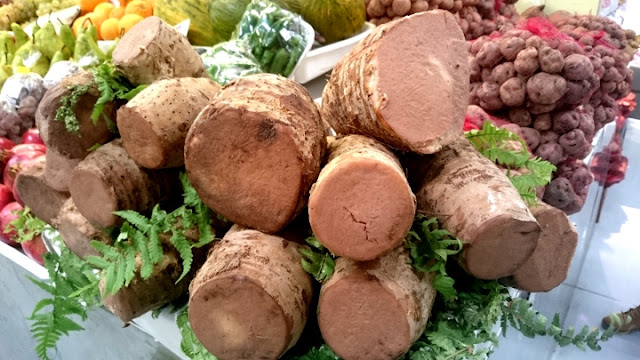
Ñames (Yams) at the Mercado (Municipal Market) in La Laguna

Stewed yam is one of the most typical products of the land on the tables of the Canary Islands, especially in Tenerife and La Palma, in the Christmas and Carnival celebrations and is undoubtedly one of the favourite desserts at Christmas. This tuber, a direct relative of potatoes, sweet potatoes and cassava, is usually served, with mojo, as a garnish to accompany salty fish, but during these holidays it is presented as an appetizer or dessert, chopped and sprinkled with sugar, cinnamon or accompanied with palm honey. 

In the Canary Islands it is one of the oldest crops (mentioned by biologist and writer José de Viera y Clavijo in the 18th Century) and present in the basic diet in the past. It's said that "yams have killed a lot of hunger", because it was an important resource, especially in times of famine or poor harvests.

The so-called ‘ñamera’ (yam plant - often seen in squares all over the islands - requires a lot of water, so the ravines and springs (patameros) are the traditional areas of cultivation on the islands. Also for this reason it is more common to find them on the northern slopes of the more humid islands, especially on La Palma; in the Macizos de Anaga and Teno in Tenerife, La Gomera and Gran Canaria.

Although it doesn't need much care, the plant can reach a height of 90 centimetres and the tuber is deep-rooted, making it difficult to harvest. This is probably why it isn't usually a cash crop. Small tubers that form at the base of adult plants, sown in pots and then transplanted, are usually used as seeds. However, the most common method is to replant tubers in spring.

In the Canary Islands, only the tuber is consumed, while in other areas of the planet the stems and leaves are also cooked. The tuber is highly valued for its sweet taste and texture, but it can only be eaten stewed, as it contains certain substances that make it indigestible raw, causing serious intestinal problems.

The manner of consumption is also different depending on the island. In Tenerife and La Palma it is usually eaten accompanied by salted fish, fried eggs, or as a dessert at Christmas, Carnival and Easter, accompanied with cheese, cinnamon and sugar, or palm honey. In Gran Canaria and La Gomera it is also added to stews and sancochos, to give them a special sweetness and thickness.

Historically, the yam leaf was also used, either to cover certain products that were to be kept fresh or moist, or as a cover for a jug to transport fresh water.

The traditional process of stewing yams in the Canary Islands is somewhat cumbersome, since it requires several days and a previous treatment of heating and drying of the tubers. So it is fortunate that already stewed yams arrive at the markets on the islands around Christmas time.

Ñames guisados, un manjar para Noche Buena

Thursday, 24 December 2020

Christmas Eve Dinner in La Laguna

Produce in the Santa Cruz de Tenerife Municipal Market

As in most Spanish provinces, there are special typical recipes for every occasion and Christmas is no exception. For those who have planned to visit on these dates, in addition to ensuring good weather, we want to guide you through our gastronomy so that you can take home a delicious memory. For those of us who celebrate it as a family, our journey through Christmas recipes undoubtedly begins by visiting the market, to the stalls to which we go year after year to acquire the best ingredients for our typical Christmas Eve dinner.

The market looks splendid as always at this time of year, adorned with garlands, lights and animated Christmas carols. In each house and on each island they have their own particular favourites, we want to show you the most common ones, the ones that are never missing from the dinner table of La Laguna families.

Starters

We start by welcoming our guests with a tray of langoustines, homemade croquettes and local cheeses with mojo sauces and, of course, the star of our starters, the famous pata de cochino asada (roast leg of pork).

Fish 

The most used on these dates are cherne (grouper) and cod that we will serve in the most traditional way, with onions and accompanied by some papas arrugadas (wrinkled potatoes) and bathed with cilantro (coriander) or spicy mojo sauce.

Meats 

Goat kid in adobo and rabbit in salmorejo are the main stars of our gastronomy although they take on a special role in our tables for Christmas.

Beyond the typical Christmas desserts such as the turrones (nougats), polvorones and marzipans, what Canarians really love to eat are the Truchas de Batata (Sweet Potato Pies) and Pella de Gofio, a delicious dough made with gofio, honey and nuts, served accompanied by a sweet local wine.

Tuesday, 24 December 2019

Christmas Eve menus in the Canary Islands


Although an eternal spring persists in the Canary Islands, Christmas is celebrated with the same enthusiasm as everywhere else. Christmas in the archipelago is not white nor do you expect to see Santa Claus transporting his gifts in a sleigh on the snow; The sun continues to shine, but even so these celebrations are the most endearing, familiar and full of traditions of the year. The traditional prevails in the gastronomy of the islands, with numerous Canarian Christmas recipes with which to share these important dates with the family.

The Canarian recipes for Nochebuena (Christmas Eve) are made for all tastes, with a wide variety of dishes and ingredients that allow all the palates of the family to be happy. The typical Canarian Christmas meals cover all types of gastronomy, from fish and meat to snacks and sweets. If you also water these delicacies with the magnificent wines of the different denominations of origin of the Fortunate Islands, the success will be complete.

If you are going to celebrate a Christmas lunch or dinner in Las Palmas, Santa Cruz de Tenerife, San Sebastián de la Gomera or in any of the wonderful cities and towns of the Canary Islands, you have a wide range of foods and recipes to celebrate the holidays with the aroma of the best island tradition.

Quesos canarios (Canarian cheeses)

Tender, creamy, cured … the assortment of Canarian cheeses is extensive and delicious. Each island has such excellent cheeses as Palmero, Majorero, Media Flor, etc., and they are the best appetizers to start the festivities.

Morcilla dulce canaria (Canarian black pudding)

Like Canarian cheeses, these sticks of sweet blood sausage are great to start the table during the feasts of the holidays. Very tasty and light, in addition to the blood sausage itself, this recipe includes almonds, raisins, aromatic herbs and spices, with a simply spectacular result.

Pata de cochino asada (Roast pork leg)

A starter that adds shine to any table. These exquisite pig feet are flavoured with garlic that is introduced into the meat through small incisions. The skin is decorated in the form of a square mosaic and is smeared with lard. Baked, the dish is crunchy on the outside and juicy on the inside that is to die for.

Cabrito en adobo y albóndigas de conejo en salmorejo (Goat kid in adobo and rabbit meatballs in salmorejo)

Two of the most classic Canarian Christmas recipes that make up two magnificent starters. Both dishes are a tribute to the senses and a way to start lunch or dinner in style. In adobo kid, the meat is marinated with sauce or adobo, while the meatballs are bathed with the traditional Canarian salmorejo and served with basmati-type rice.

Pescado encebollado (Fish with onions)

Recipes with seafood cannot be absent in the Canary Islands, where they are one of the great foundations of its gastronomy. The fish most used during the Christmas holidays are cod and cherne (grouper), which are made with onions and accompanied by wrinkled potatoes with red or green mojo, other classics of island cuisine.

Lapas a la plancha con mojo verde (Grilled limpets with green mojo sauce)

Very simple recipe and also very popular in the Canary Islands. With very few ingredients (limpets, olive oil, parsley, coarse salt and the classic green mojo) you have a dish with a delicious seafood flavour that any fan of good food will fall in love with.

Crema de salmón (Salmon cream)

A perfect first dish made with salmon, potatoes, vegetables and milk. Although its preparation is somewhat slow (you will need about an hour), it results in a delicious dish for which it is well worth the wait a bit.

Conejo al salmorejo (Rabbit in salmorejo)

One of the Canarian Christmas recipes par excellence, which is usually served as a second course and which is a guarantee of success due to its simplicity and flavour. An infallible bet that, requires the meat to be marinated for a full day.


Postres canarios (Canarian desserts)

The icing on the cake (pun intended) of a good Christmas feast are some of the many wonderful Canarian desserts. The best way to end meals with a smile before moving on to sparkling wines, cavas, and other spirits over lively table settings. Let's see some of the essentials: 

Truchas de batata (Sweet potato turnovers)

OK, trucha actually means and translates to trout, but no, they are not fish for dessert! Canarian turnovers with sweet potato are puff pastry filled with sweet potato, lemon, almond, egg yolks, sugar, cinnamon and anise. An explosion of flavour typical of the Christmas season in the archipelago that provokes a real enthusiasm in the whole family.

Dulces tradicionales (Traditional sweets)

The typical Canarian desserts are the best finish for any menu, and there is a good variety on the islands: Tejeda almond polvorones, gofio mousse, Moya sponge cakes, almond cheese ... they are perfect as culmination of banquets.


The Canarian Christmas recipes are a real gift to enjoy these endearing holidays in the company of the family and with the privilege of being able to do so in a spring climate. But don't be surprised if you see Santa Claus carrying his gifts in shorts and on a surfboard.

Monday, 24 December 2007

Christmas Eve Traditions in Tenerife

Church of Our Lady of the Consolation in El Palmar

The main celebrations in the Canary Islands, as in most European countries, are on Nochebuena (Christmas Eve), when the family get together to share an evening meal. Food revolves around the sweet treats, with Truchas de Batata (sweet potato pies) plus fruit, nuts and a huge array of seasonal sweets.

For many years I spent Christmas Eve, Nochebuena, in 'El Pueblo' (the village), Canarian style. The typical fayre, generally, is barbecued meat with boiled potatoes. Yams are usually eaten after the meal, sweetened with sugar or honey (palm honey is good too). If resources permit, a whole goat kid or suckling pig is preferable as tradition dictated that this meal should not be of fish. For many poor families here, Christmas Eve is one of the few celebration times when they will have any quantity of meat, so it is very simply prepared and quickly enjoyed.

Celebrations may go on quite late and the gathered family will probably start singing and playing Canarian Folk music. This isn't traditionally a time for the exchanging of gifts: traditionally, that comes later, at Epiphany, although the fortunate few kids may get some gifts from Santa now and the rest from The Kings later, as it gives them time to play with toys during the holidays.

Long ago the Christmas Eve meal was served after attending the Misa de Gallo (Midnight Mass): the 24th being a day of fasting and abstinence, but that has tended to change these days. The mass, at which carols may be sung, being left out altogether by a large majority. In Los Cristianos and other multi-nationally populated areas, there are usually carol services in a wonderful pot-purri of Spanish, English, German and Latin. In smaller villages, local children perform the Nativity (often with humorous interpretation), while folk groups provide the accompaniment. One year at El Palmar, the dialogue translated, roughly:

Joseph: (to innkeeper) "Can we come in, only my wife isn't feeling too good?"

Innkeeper: "Well, if she's ill she can't come in here. Take her to the health centre!

I don't remember that being in the original version. It was truly unexpected and had everyone rolling in the isles at the Nativity in the little church.