The most detailed English language website on the island

Weather - Tutiempo.net
     

After more than 20 years, posts here will now only be occasional (see why) for big events such as Tenerife Carnaval, so please "Like" and follow our Facebook Page to get future updates.

Showing posts with label Christmas in Tenerife. Show all posts

Monday, 3 January 2022

The pagan origin of the “Roscón de Reyes”

Roscón de Reyes from Pasteleria El Aderno in Buenavista del Norte

In Spain it's Epiphany, January 6th - the Feast of The Three Kings - that is the biggest day of the season's celebrations, the Three Kings having arrived, bearing gifts, on the night of January 5th. And the one indispensable item at the table is the Roscón de Reyes. It's easy to see that the Roscón, along with the French Galette des Rois, the King Cakes in Louisiana (albeit transplanted to Mardi Gras) and even the Twelfth Night cake that eventually became our Christmas Cake all developed from the same root. As Christendom spread across Europe, the cake caught on. Now you can find this formerly pagan cake on the Christmas tables of families throughout Spain, France, and Latin America!

At the Roman festivities of Saturnalia each December, the roscón, a circular cake in which a bean was hidden, was a tradition. The one who found the bean became the “king of the feast” and all those present had to obey his/her orders. 

This is the same as the tradition in Tudor Christmas celebrations, where whoever received the slice of cake containing the bean was ‘crowned’ the Lord of Misrule. He was like a mock king and supervised entertainments or rather unruly events involving drinking, revelry, role reversal, and general chaos. During the medieval and Tudor periods, the Twelfth Night Cake was leavened with yeast, rather like a fruit-laden brioche - much more like the recipe for the Roscón de Reyes. The introduction of cake hoops in the late seventeenth century and the discovery during the early eighteenth century that beaten eggs could be used to raise a cake meant that the fruit breads of earlier times were replaced by a plum cake.

We later transported the bean to become the sixpence in the Christmas pudding. 

Over the centuries, finding the bean in the Roscón de Reyes in Spain became "unlucky". Nowadays, the bakers will tell you that the finder just has to buy the next cake, while, the "lucky" people find either a ceramic baby Jesus. Even luckier are those who bought the Roscón de Reyes from El Aderno in Tenerife that contained a set of all three ceramic Kings, as well as the bean.

(We've published the recipe for a Roscón de Reyes and it is nowhere near as difficult as the result makes it look. You really should try it some time.)

Friday, 24 December 2021

Why is Mass on Dec 24 called "Misa del Gallo"?

Un Gallo (A Rooster)

Among all the religious events that are celebrated during the Christmas season we find the "Misa del Gallo" (literally Rooster's Mass), which takes place at midnight on Christmas Eve, December 24, the beginning of Christmas day.

Most historians and authoritative voices on the liturgical theme point, as the origin of this traditional religious commemoration of the birth of Jesus, to Pope Sixtus III who, in the 5th century, established the custom of celebrating a night vigil mass at midnight on the day of celebration of the Messiah's birth, “ad galli cantus” (at the crowing of the rooster). The "ad galli cantus" referred to the moment when the new day begins, according to ancient Roman traditions, at midnight.

But not all sources agree, as there are those who attribute it to an ancient fable that tells that during the birth of Jesus there was a rooster in the stable, which was the first living being witness the event and thus to proclaim it, first to the mule and the ox, then to the shepherds and their sheep and finally to the people who lived in the surroundings and, therefore, the coming to the world of the Messiah was announced "ad galli cantus", when the rooster crowed.

Another theory, poorly documented and lacking enough credibility, maintains that the name is due to the fact that, in the past, in some countries the Christmas Eve dinner menu consisted of a roasted rooster! There are also those who insist that the origin of the name of the Mass of the Rooster has its origin in its celebration in the Church of Saint Peter in Gallicantu in Jerusalem. This church took its name from the evangelical episode that recounted how Jesus warned Peter that he would deny him three times before the rooster crowed.

Although it is an ingrained custom to celebrate it at midnight, the Mass schedule is often adapted to the needs of the community and can be advanced. 

Wednesday, 22 December 2021

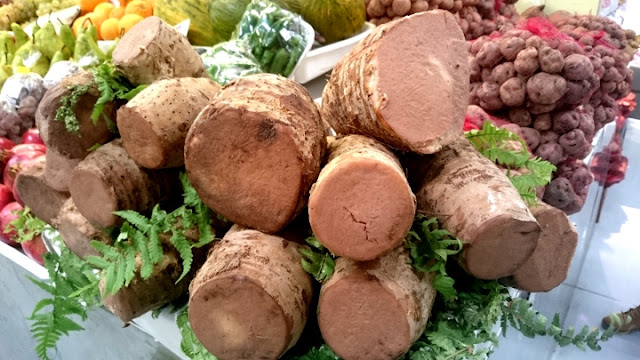
Stewed yams, a delicacy for Christmas Eve

Ñames (Yams) at the Mercado (Municipal Market) in La Laguna

Stewed yam is one of the most typical products of the land on the tables of the Canary Islands, especially in Tenerife and La Palma, in the Christmas and Carnival celebrations and is undoubtedly one of the favourite desserts at Christmas. This tuber, a direct relative of potatoes, sweet potatoes and cassava, is usually served, with mojo, as a garnish to accompany salty fish, but during these holidays it is presented as an appetizer or dessert, chopped and sprinkled with sugar, cinnamon or accompanied with palm honey. 

In the Canary Islands it is one of the oldest crops (mentioned by biologist and writer José de Viera y Clavijo in the 18th Century) and present in the basic diet in the past. It's said that "yams have killed a lot of hunger", because it was an important resource, especially in times of famine or poor harvests.

The so-called ‘ñamera’ (yam plant - often seen in squares all over the islands - requires a lot of water, so the ravines and springs (patameros) are the traditional areas of cultivation on the islands. Also for this reason it is more common to find them on the northern slopes of the more humid islands, especially on La Palma; in the Macizos de Anaga and Teno in Tenerife, La Gomera and Gran Canaria.

Although it doesn't need much care, the plant can reach a height of 90 centimetres and the tuber is deep-rooted, making it difficult to harvest. This is probably why it isn't usually a cash crop. Small tubers that form at the base of adult plants, sown in pots and then transplanted, are usually used as seeds. However, the most common method is to replant tubers in spring.

In the Canary Islands, only the tuber is consumed, while in other areas of the planet the stems and leaves are also cooked. The tuber is highly valued for its sweet taste and texture, but it can only be eaten stewed, as it contains certain substances that make it indigestible raw, causing serious intestinal problems.

The manner of consumption is also different depending on the island. In Tenerife and La Palma it is usually eaten accompanied by salted fish, fried eggs, or as a dessert at Christmas, Carnival and Easter, accompanied with cheese, cinnamon and sugar, or palm honey. In Gran Canaria and La Gomera it is also added to stews and sancochos, to give them a special sweetness and thickness.

Historically, the yam leaf was also used, either to cover certain products that were to be kept fresh or moist, or as a cover for a jug to transport fresh water.

The traditional process of stewing yams in the Canary Islands is somewhat cumbersome, since it requires several days and a previous treatment of heating and drying of the tubers. So it is fortunate that already stewed yams arrive at the markets on the islands around Christmas time.

Ñames guisados, un manjar para Noche Buena

Tuesday, 14 December 2021

Truchas de Batata (Sweet Potato Turnovers)

Truchas de Batata

One of my, admittedly many, favorite sweet things of the Christmas season are these delicious little Truchas de Batata (Sweet Potato Turnovers). Since you may not have them available in the shops near you, here's the recipe:

Ingredients:

For the pastry:
3 tablespoons of lard
1 small glass of olive oil
500 grams (1 l.b.) flour.

For the filling:
500 grams (1 l.b.) sweet potatoes
250 grams (8 Oz) ground almonds
1 small cup of caster sugar
3 egg yolks
A teaspoon of aniseed
A dash of rum
A dash of aniseed liqueur
A teaspoon of ground cinnamon
Grated lemon rind
Oil for frying.

Preparation:

Filling: Boil the sweet potatoes in water with a little salt. When they're done, peel them, pound to a pulp and mix them with the almonds, flavourings and liqueurs.

Pastry: Mix together lard, oil and flour until a mass is formed and leave to rest for a short time. Cover a surface with flour and roll out the pastry until very thin. Cut out small rounds with a cup and put a small amount of filling into the centre of each. Close them by folding in half to make little semi-circular patties. Press down and seal with the aid of a fork. Fry in hot oil then sprinkle with sugar to serve.

Sunday, 12 December 2021

Turrón de Jijona (Spanish Almond Candy)

Turrón de Jijona

There is no more typical Christmas sweet in Spain than turrón. The recipe for turrón should never contain less than 10% of honey or 64% of almonds. There are two traditional basic types of turrón. Soft Jijona or turrón blando, which is so smooth it has the consistency of peanut butter and hard Alicante or turrón duro, which is like a thick almond nougat candy, similar to peanut brittle. 

Ingredients for 4 tablets:
  • 400 grams of honey (azahar - orange blossom honey is traditional) 
  • 200 grams of sugar
  • 1 egg white
  • 700 grams of almonds, peeled and toasted
  • the grated rind of half a lemon

Method:

Grind the almonds without letting them become completely pulverized. Pour the honey and the sugar into a saucepan and put it to heat over a low flame, stirring with a wooden spoon until the sugar is dissolved and the mixture thickens. Remove the mixture from the heat.

Beat the egg white and add it to the honey and sugar mixture. Mix well without pausing for 10-15 minutes then place the mixture back on a low heat until the mixture begins to caramelise and take on a deeper colour.

Add the almonds and the grated lemon rind to the mixture. Mix well with a wooden spoon and leave to cool for 5 minutes.

Line moulds with grease proof kitchen paper, pour the mixture into the moulds so that the turrón is around 2 - 3 cm thick. Leave for 3 - 4 hours to set to the right consistency, then turn out and store in Tupperware boxes in a cool, dry place.

Translated from this recipe

Wednesday, 8 December 2021

Turrón de Chocolate (Chocolate Fudge)

Turrón de trufa negra con Yogur y Grosellas Rafa Gorrotxategi

This typical Christmas sweet is simple to make even for kids.

Ingredients for one bar of turrón:
250 grams of butter
250 grams of crumbled cake
100 grams (4 Oz) of almonds
100 grams (4 Oz) of walnuts
1 x 150 gram (6 Oz) tablet of chocolate
8 tablespoons of sugar

Method: Put the chocolate in a basin over a saucepan of hot water and leave it to melt. Work the butter with the sugar until you obtain a creamy consistency. Add the tepid chocolate to the cream with the crumbled cakes and mix the whole lot together well. Add the almonds and walnuts, well chopped. Turn the mixture into a rectangular mold, lined with greaseproof paper that has been spread with butter. Leave it to set in the fridge for 24 hours before removing from the mould.

Tuesday, 7 December 2021

Turrón de gofio (Gofio nougat)

Turrón de gofio (Gofio nougat)

There are many ways to eat the Canarian staple, gofio, but in the run up to Christmas, what better way than as the traditional, seasonal sweet, turrón.

Ingredients:

100 gr gofio de millo (corn gofio)
75 gr of honey
125 gr ground almonds
50 gr of sugar

Method:
  1. Toast the gofio in a non-stick pan over a low heat, stirring. Once toasted remove from heat and let cool slightly.
  2. Meanwhile, put the sugar in a saucepan on the heat and allow it to caramelize. When the sugar acquires caramel texture, add the ground almonds and stir for a few minutes.
  3. Place baking paper into the mould you have chosen for the preparation of this nougat (you can use a rectangular silicone mould or half of a milk brick).
  4. Pour the almond and caramel mixture onto the baking paper, and allow to cool slightly.
  5. When it is cool enough to handle, add the gofio and honey and knead so that it is well integrated.
  6. Put the dough back into the mould lined with baking paper, flatten the surface, cover with more baking paper and place in the fridge for a few hours.

Translated from: Turrón de gofio: 2 recetas de Navidad canaria

Sunday, 5 December 2021

Polvorones (Powder Cakes)

Polvorón de Estepa. Photo: Marianne Perdomo [CC BY-SA 4.0]

Among indispensable sweet things for Christmas are Polvorones. (Spoil yourself, it's only once a year!) So, here's a simple recipe for making them.

Ingredients:

500 grams (1 l.b.) of sugar
500 grams (1 l.b.) of lard
1 KG (2 lbs.) of flour
A good pinch of ground cinnamon
The grated rind of a green lemon
A good pinch of ground aniseed

Preparation:

Put all the ingredients in a bowl and mix with the hands until it forms a paste. To make the polverones, take small handfuls of the mixture and make into small ovals, something like cookies. Place the polverones onto a baking tray, greased with butter or lard, and bake them in the oven until golden brown.

Thursday, 24 December 2020

Christmas Eve Dinner in La Laguna

Produce in the Santa Cruz de Tenerife Municipal Market

As in most Spanish provinces, there are special typical recipes for every occasion and Christmas is no exception. For those who have planned to visit on these dates, in addition to ensuring good weather, we want to guide you through our gastronomy so that you can take home a delicious memory. For those of us who celebrate it as a family, our journey through Christmas recipes undoubtedly begins by visiting the market, to the stalls to which we go year after year to acquire the best ingredients for our typical Christmas Eve dinner.

The market looks splendid as always at this time of year, adorned with garlands, lights and animated Christmas carols. In each house and on each island they have their own particular favourites, we want to show you the most common ones, the ones that are never missing from the dinner table of La Laguna families.

Starters

We start by welcoming our guests with a tray of langoustines, homemade croquettes and local cheeses with mojo sauces and, of course, the star of our starters, the famous pata de cochino asada (roast leg of pork).

Fish 

The most used on these dates are cherne (grouper) and cod that we will serve in the most traditional way, with onions and accompanied by some papas arrugadas (wrinkled potatoes) and bathed with cilantro (coriander) or spicy mojo sauce.

Meats 

Goat kid in adobo and rabbit in salmorejo are the main stars of our gastronomy although they take on a special role in our tables for Christmas.

Beyond the typical Christmas desserts such as the turrones (nougats), polvorones and marzipans, what Canarians really love to eat are the Truchas de Batata (Sweet Potato Pies) and Pella de Gofio, a delicious dough made with gofio, honey and nuts, served accompanied by a sweet local wine.

Tuesday, 24 December 2019

Christmas Eve menus in the Canary Islands


Although an eternal spring persists in the Canary Islands, Christmas is celebrated with the same enthusiasm as everywhere else. Christmas in the archipelago is not white nor do you expect to see Santa Claus transporting his gifts in a sleigh on the snow; The sun continues to shine, but even so these celebrations are the most endearing, familiar and full of traditions of the year. The traditional prevails in the gastronomy of the islands, with numerous Canarian Christmas recipes with which to share these important dates with the family.

The Canarian recipes for Nochebuena (Christmas Eve) are made for all tastes, with a wide variety of dishes and ingredients that allow all the palates of the family to be happy. The typical Canarian Christmas meals cover all types of gastronomy, from fish and meat to snacks and sweets. If you also water these delicacies with the magnificent wines of the different denominations of origin of the Fortunate Islands, the success will be complete.

If you are going to celebrate a Christmas lunch or dinner in Las Palmas, Santa Cruz de Tenerife, San Sebastián de la Gomera or in any of the wonderful cities and towns of the Canary Islands, you have a wide range of foods and recipes to celebrate the holidays with the aroma of the best island tradition.

Quesos canarios (Canarian cheeses)

Tender, creamy, cured … the assortment of Canarian cheeses is extensive and delicious. Each island has such excellent cheeses as Palmero, Majorero, Media Flor, etc., and they are the best appetizers to start the festivities.

Morcilla dulce canaria (Canarian black pudding)

Like Canarian cheeses, these sticks of sweet blood sausage are great to start the table during the feasts of the holidays. Very tasty and light, in addition to the blood sausage itself, this recipe includes almonds, raisins, aromatic herbs and spices, with a simply spectacular result.

Pata de cochino asada (Roast pork leg)

A starter that adds shine to any table. These exquisite pig feet are flavoured with garlic that is introduced into the meat through small incisions. The skin is decorated in the form of a square mosaic and is smeared with lard. Baked, the dish is crunchy on the outside and juicy on the inside that is to die for.

Cabrito en adobo y albóndigas de conejo en salmorejo (Goat kid in adobo and rabbit meatballs in salmorejo)

Two of the most classic Canarian Christmas recipes that make up two magnificent starters. Both dishes are a tribute to the senses and a way to start lunch or dinner in style. In adobo kid, the meat is marinated with sauce or adobo, while the meatballs are bathed with the traditional Canarian salmorejo and served with basmati-type rice.

Pescado encebollado (Fish with onions)

Recipes with seafood cannot be absent in the Canary Islands, where they are one of the great foundations of its gastronomy. The fish most used during the Christmas holidays are cod and cherne (grouper), which are made with onions and accompanied by wrinkled potatoes with red or green mojo, other classics of island cuisine.

Lapas a la plancha con mojo verde (Grilled limpets with green mojo sauce)

Very simple recipe and also very popular in the Canary Islands. With very few ingredients (limpets, olive oil, parsley, coarse salt and the classic green mojo) you have a dish with a delicious seafood flavour that any fan of good food will fall in love with.

Crema de salmón (Salmon cream)

A perfect first dish made with salmon, potatoes, vegetables and milk. Although its preparation is somewhat slow (you will need about an hour), it results in a delicious dish for which it is well worth the wait a bit.

Conejo al salmorejo (Rabbit in salmorejo)

One of the Canarian Christmas recipes par excellence, which is usually served as a second course and which is a guarantee of success due to its simplicity and flavour. An infallible bet that, requires the meat to be marinated for a full day.


Postres canarios (Canarian desserts)

The icing on the cake (pun intended) of a good Christmas feast are some of the many wonderful Canarian desserts. The best way to end meals with a smile before moving on to sparkling wines, cavas, and other spirits over lively table settings. Let's see some of the essentials: 

Truchas de batata (Sweet potato turnovers)

OK, trucha actually means and translates to trout, but no, they are not fish for dessert! Canarian turnovers with sweet potato are puff pastry filled with sweet potato, lemon, almond, egg yolks, sugar, cinnamon and anise. An explosion of flavour typical of the Christmas season in the archipelago that provokes a real enthusiasm in the whole family.

Dulces tradicionales (Traditional sweets)

The typical Canarian desserts are the best finish for any menu, and there is a good variety on the islands: Tejeda almond polvorones, gofio mousse, Moya sponge cakes, almond cheese ... they are perfect as culmination of banquets.


The Canarian Christmas recipes are a real gift to enjoy these endearing holidays in the company of the family and with the privilege of being able to do so in a spring climate. But don't be surprised if you see Santa Claus carrying his gifts in shorts and on a surfboard.

Wednesday, 18 December 2019

Almendras Garrapiñadas (Candied Almonds)

Almendras Garrapiñadas (Candied Almonds) on sale at a fiesta in La Orotava.

Almendras Garrapiñadas (Candied Almonds) are an indispensable part of every fiesta in Spain, but are also popular at Christmas. They're also common in Denmark, Norway and Sweden, being frequently sold at Christmas markets. Or, perhaps you might like to have a go at making them yourself from this recipe:

Ingredients:
  • 200 grams of almonds with skin
  • 250 grams of granulated sugar 
  • 250 grams of water (a quarter of a liter of water)
  • 1 sachet of vanilla sugar or 1 tablespoon of vanilla essence 
Method:
  1. Put the water, sugar and almonds into a saucepan. Add an envelope of vanilla sugar (about 8 grams) or a spoonful of vanilla essence. Put the saucepan over medium heat and you will see how the sugar dissolves into the water and begins taking on the color of the almond skin. (If you use almonds without skin, the caramel is not good, and the caramel will not take on the skin color of the almonds.) Maintain over medium heat until the syrup that forms begins to boil and foams.
  2. Lower the heat, so that the boil is maintained minimally, without raising the temperature of the syrup. Stir with a wooden spatula (do not use a metal one or you will burn yourself) and the water will evaporate and the syrup will be reduced. It is not possible to evaporate the water without lowering the temperature so do not look for shortcuts in this or it will burn everything (if it smells like burning, you've gone wrong).
  3. At this point the syrup will appear to contain sand and then all the water will disappear leaving a completely dry sandy mixture. Do not stop stirring constantly.
  4. Now raise the temperature, but only a little. (If you raise the heat too much, all the sugar will turn into caramel and the almonds will stick to each other.) So turn up the heat just a little so that the sugar caramelizes, little by little. Stir constantly so that the caramel is wrapped around the almonds being quite loose from each other.
  5. When the caramelized almonds are ready, place them on baking paper. When they are somewhat less hot, but without letting them cool completely, separate the ones that have remained together and then let them cool completely. 
Whenever you work with sugar and heat you have to be very careful. Candy is one of the hottest things in a kitchen and its burn is very serious. Well caramelized, the almonds will last in an airtight container for several weeks.

Receta para hacer Almendras Garrapiñadas

Wednesday, 11 December 2019

Flavours of Christmas in La Laguna: Solomillo al Aguere (Pork Tenderloin Aguere Style)

Pork Tenderloin with Pedro Ximenez sauce 

Dried fruits turn up in Christmas recipes from so many different parts of the world that it's easy to see how this too epitomises the flavours of Christmas. This recipe is for Solomillo al Aguere: Solomillo translates to sirloin, in this case of pork, Aguere style (Aguere is a district near the centre of La Laguna.)

Ingredients for 4 people:

4 pork tenderloins
1 large onion
250 ml of chicken stock
125 ml of Pedro Ximénez wine
5 tablespoons muscat raisins (about 80 grams)
1 tablespoon flour
olive oil
salt and black pepper

Method 

Peel the onion and cut into thin julienne strips. Place over medium heat with 8 tablespoons of oil in a large pan (into which the sirloins and the sauce should fit afterwards). Let the onions poach until they're transparent. If they should begin to burn, lower the heat and if necessary add a tablespoon of water.  Put the raisins to soak in a glass of water.

Season the pork tenderloins with salt and pepper on both sides. In a large pan, brown two of the tenderloins over a high heat. When they're golden, remove the tenderloins and add the other two. When ready remove the tenderloins, but leave the pan on the heat.

Pour the Pedro Ximénez (in the UK, Tesco sell this) wine into the pan. With a wooden spoon (or a wooden spatula), stir the wine through to deglaze the pan. Turn off the heat and set aside.

At this point the onion should be well poached. Add a tablespoon of flour to the onions and stir well (taking care that the flour does not stick) for a few seconds so that the flour becomes colored (and cooks through). Then pour the Pedro Ximénez wine and meat juices from the pan onto the onions. Stir for a minute, add the tenderloins and the hot chicken stock. Drain the raisins and add them to the sauce. Let the sauce simmer until it thickens to your liking. Try the sauce and season if necessary. And that's it.

Translated from: Sabores de La Navidad lagunera. Solomillo al Aguere

Saturday, 22 December 2018

Spanish Christmas Lottery 22nd December

An El Gordo Spanish Christmas Lottery ticket from 2009

On 22nd December each year, the Spanish Christmas Lottery, the biggest lottery in the world and an eagerly-awaited kick-start to Christmas, is drawn. In 2017 there were 2,380 million euros in the El Gordo (The Fat One) prize pot. In this video, Tom Bacon explains how the whole El Gordo lottery works.


How the numbers are picked

Every 22nd December from 9am in the morning forty children aged 8 to 14 years old from the school 'Colegio de San Ildefonso' in Segovia, which was formerly an orphanage, draw the winning numbers. The children are called 'los niños de San Ildefonso' and in pairs they draw the small wooden numbered balls out of the two big golden drums that contain all 100.000 numbers. One drum has the ticket numbers and the other has the prize amounts. The children come forward in pairs and draw and sing out a lottery ticket number from one drum, and then draw and sing out the prize amount to be awarded to that number from the other drum. This lottery ceremony that takes place at the Teatro Real de Madrid and takes just over three hours, is called 'el soniquete de los Niños de San Ildefonso.' It's very sweet and Christmas in Spain just wouldn't be the same without it.

Naturally because of the money involved it's very exciting viewing if you have a ticket watching the winning numbers as they are called out.

Monday, 11 December 2017

Follow The Route of Nativities in Tenerife

From the huge, life-size nativity outside the town hall in La Orotava.

The Nacimiento (Nativity) or Belén (Bethlehem) is the most important of Christmas decorations in Tenerife. In most homes, this is arranged under the tree. Oh, don't expect "historical accuracy" in homes. I've seen both Jedi and Barbie dolls attending the baby Jesus, along with the shepherds and Magi! 

Organized Nativity displays are something else. Town Halls and Associations produce massive works of art each year. Not just stable scenes, but whole Holy model towns - often, inexplicably, depicting the Canarian location they're at - with working windmills, lights & everything! These "Holy Model Villages" full of detail usually reserved for model railways, are fascinating to see and won't be difficult to find, all around the island. It's well worth the trip to visit them. 

In Tenerife's capital, Santa Cruz, there are several famous public Belén displays. 

One, organized by Santa Cruz Town Hall, in the exhibition hall (Aula Magna) of the Cultural Park, Parque Cultural Viera y Clavijo, one year covered 55 square meters with more than 600 hand-made pieces, plus numerous lighting effects and movements, such as the breaking of dawn, nightfall, a storm with winds, thunder and lightening, the apparition of an angel, rivers and canals, the baby crying.

There are specialist belenistas (nativity makers), contests and organised routes to go round and see them; private family nativities (some of which open their homes to the public), then there are regular public nativities in squares, such as the life-size nativity outside the town hall in La Orotava, (see above), in the Plaza de Candelaria in Santa Cruz, in shops and malls, such as La Villa in La Orotava, inside the Cabildo (Tenerife Island Corporation) building in Santa Cruz, in town halls, most churches (of course) and, even hotels.

Not every detail is serious mind you, as this and Jack Montgomery explains.

Most of the nativity displays are available to see from early December, usually until Los Reyes (The Three Kings Day) on January 6th.

Monday, 4 December 2017

Towns fill with poinsettias for Christmas

Varigated 'municipal' poinsettias in La Laguna

In 2005, the Tenerife Island Council is supplied 65,000 Flor de Pascua (poinsettia) plants to town halls across the island in order to dress up parks and squares for the Christmas festivities. The plants are specially cultivated in island nurseries and are distributed each year for the seasonal decorations.

Where can you see them? Well, the plants are shared out according to the number of inhabitants in each district, so Santa Cruz get the largest number with 6,000 plants, with La Laguna (5,000) and Arona (4,000) second and third. Icod de los Vinos will be getting 2,000 poinsettia plants to adorn the town, while Buenavista del Norte, Los Silos and Garachico will receive 1,000 each.

Hundreds more are given to various associations and centres providing social services, so the plants are bound to brighten someone's season.

Every town and village will be decorated for Christmas and parks, squares and verges planted with a plethora of bright and festive Flor de pascua (poinsettia) plants. In this video from 2012, it's mentioned that 45,000 of them were planted in the city of Santa Cruz alone and school kids from all over the island grew the seedlings and help with planting. Unfortunately, the plants are so attractive, that people steal them from the displays and in an effort to deter them, the plants are now planted directly in the soil and not in easy to carry off plant pots.

Friday, 1 December 2017

Tenerife in December 2017

Along with the countdown to Christmas, comes the excited wait to see if there will be snow on Teide.
Photo By Jens Steckert (Own work) [GFDL, CC-BY-SA-3.0 or CC BY-SA 2.5]

December begins with two National public holidays: on Wed, 6th December for Día de la Constitución Española (Constitution Day) and Fri, 8th December for Inmaculada Concepción (The Immaculate Conception). Many people will take the day off on Thursday, 7th too and take what's known as un puente (translates to bridge) or short break. Most of December's events are to do with Christmas.

The holiday period always kicks off proper with El Gordo (The Fat One), the Spanish Christmas Lottery, which is drawn on 22nd December each year, with kids singing out the results during a five-hour televised spectacular.

Christmas Day, Monday, 25th December 2017 will be a Public holiday. For Canarians, this is often recovery day after a big family gathering on Christmas Eve. Boxing Day isn't a tradition nor holiday in Spain or the Canaries.

On Christmas Day at 9pm, in the open air beside the port in Santa Cruz, the annual free Concierto de Navidad (Christmas Concert) by the Orquesta Sinfónica de Tenerife (Tenerife Symphony Orchestra) will be performed. This event is generally televised by RTVE and, is always a wonderful seasonal gift.

There are no municipal public holidays in December.

On 28th December, beware of El Día de Los Santos Inocentes (Day of the Innocent Saints), the Spanish equivalent of April Fool's Day. 

And that, of course, brings us to the end of the year and New Year's Eve.

Tuesday, 25 December 2007

Christmas Day - Día de Navidad

Teide with snow

Many locals and tourists alike visit Mount Teide on Christmas Day - which can be snow-capped at this time of year - that it's almost a ritual. The trip - only an hour or so's drive - is a real "Christmas experience", passing through the Canary pine forests, seeing the vast number of wild poinsettias and other natural Christmas decorations en route. You can just stay in the resort, but it seems such a shame, when you have all this natural, real Christmas ambience on the doorstep.

Wrap up in a jacket, but if you get cold, call into one of the mountain's bars for churros con chocolate ... hot chocolate into which you dip the now popular donut things. Provided you're not the day's designated driver, you might also like to try a Lumumba, which is hot chocolate and brandy. Lethal at high altitude.

Play in the snow, then just an hour or so later, you could be back on the beach, enjoying the average 22-26º C (71-79º F) year-round temperatures.

Where else in the world can you do all of this on Christmas Day?

Christmas Lunch

For most locals, Christmas Day is just a recovery day from the celebrations of Christmas Eve. Whilst you can get a traditional British-style Christmas Lunch in the resorts, don't expect there to be a Christmas menu at the few Canarian restaurants you may find open elsewhere. Many will close, except those in areas where they expect there to be any number of tourists. In homes, rabbit was the traditional fayre, a Canarian staple, or a barbecued goat kid, but the quantity of turkey being sold in supermarkets has risen sharply in recent years.

One year, before their commercial arrival, two turkeys were acquired by my neighbours, brought up in someone's mother's back yard. I'm not really keen on personally knowing my dinner in life and thought it poetic justice when the chap who had been given the job of dispatching the victim, presented his finger, all bandaged, after the unfortunate bird had put up a bit of resistance.

In the evening, watch the annual Christmas Day Concert from Santa Cruz.

Monday, 24 December 2007

Christmas Eve Traditions in Tenerife

Church of Our Lady of the Consolation in El Palmar

The main celebrations in the Canary Islands, as in most European countries, are on Nochebuena (Christmas Eve), when the family get together to share an evening meal. Food revolves around the sweet treats, with Truchas de Batata (sweet potato pies) plus fruit, nuts and a huge array of seasonal sweets.

For many years I spent Christmas Eve, Nochebuena, in 'El Pueblo' (the village), Canarian style. The typical fayre, generally, is barbecued meat with boiled potatoes. Yams are usually eaten after the meal, sweetened with sugar or honey (palm honey is good too). If resources permit, a whole goat kid or suckling pig is preferable as tradition dictated that this meal should not be of fish. For many poor families here, Christmas Eve is one of the few celebration times when they will have any quantity of meat, so it is very simply prepared and quickly enjoyed.

Celebrations may go on quite late and the gathered family will probably start singing and playing Canarian Folk music. This isn't traditionally a time for the exchanging of gifts: traditionally, that comes later, at Epiphany, although the fortunate few kids may get some gifts from Santa now and the rest from The Kings later, as it gives them time to play with toys during the holidays.

Long ago the Christmas Eve meal was served after attending the Misa de Gallo (Midnight Mass): the 24th being a day of fasting and abstinence, but that has tended to change these days. The mass, at which carols may be sung, being left out altogether by a large majority. In Los Cristianos and other multi-nationally populated areas, there are usually carol services in a wonderful pot-purri of Spanish, English, German and Latin. In smaller villages, local children perform the Nativity (often with humorous interpretation), while folk groups provide the accompaniment. One year at El Palmar, the dialogue translated, roughly:

Joseph: (to innkeeper) "Can we come in, only my wife isn't feeling too good?"

Innkeeper: "Well, if she's ill she can't come in here. Take her to the health centre!

I don't remember that being in the original version. It was truly unexpected and had everyone rolling in the isles at the Nativity in the little church.

Sunday, 24 December 2006

Secret Christmas Recipes of Tenerife Nuns

Convento de Santa Catalina La Laguna Koppchen [CC BY 3.0]

In the past one would see long queues of people at the back of the Convent of Santa Catalina in La Laguna, Tenerife, there to buy Christmas sweets from the turntable that was the nun's only method of delivering their goods, unseen, to the public. Today, the nuns' hand-made Christmas delicacies are sold to order, since there are not as many nuns as there were in the convent olden times to carry out the necessary work, but those who have tasted these delights certainly don't mind how much they cost, because they have the pure flavour of tradition.

The Santa Catalina nuns are experts in special foodstuffs for Christmas Eve.

An old document from 1767 recounts that the nuns dined on eggs and chocolate and, that on the following day, being Christmas, their menu was based on meat, a fig pudding, roscas de manteca (lard cakes) and mistela. (Vin de liqueur.) 

In the past they made deserts, now disappeared, such as one based on rice with sugar, almonds and cinnamon. The Mother Superior of the Santa Catalina convent, Sister María Cleofé López Lantigua, underlined that they continue to faithfully maintain the Christmas sweet making tradition. Although they used to make more sweets, production has been reduced, attending only to the orders from those persons who collaborate with the convent. This is because, she added, "there are very few nuns to do the work and, given the hours it takes, it isn't profitable." Though she doesn't reject the idea of opening a dulcería in the convent, teaching their culinary arts to youngsters via a workshop and school and, if the authorities don't apply heavy taxes, the money can be a benefit to the community and be used to restore the convent.

The current sweet and pastry maker in the Santa Catalina convent is Sister María Inés de León Domínguez, who is 71 years old. Sister Inés, who was born in La Orotava, learned the art from her grandmother, Remedios Méndez.

Sister Inés has lived in the La Laguna convent for 54 years, delighting many with her culinary magic and special flavours.

One of her principal specialities are rosquetes de vino, which are made with nutmeg, cinnamon, liqueur, flour, lard and salt. Then there are her galletas de leche (milk biscuits), formed with antique metal cutters in shapes of hearts, clubs and half moons, made with oil, butter, flour, milk and almond or coconut.

The mantecados (lard cakes), typical of the Christmas season, Sister Inés makes with lard, lemon, cinnamon, aniseed liqueur, flour, salt and ground almonds and, that are then decorated with a piece of crystallized fruit.

Her rosquetes de palo follow an ancient recipe, made with oil, flour, lard and wine, to which is added water mixed with aniseed liqueur. She also makes truchas de batata (sweet potato pies) and tocinos de cielo (caramel puddings).

The star of the Santa Catalina nun's recipes though, is the tarta de almendra (almond tart), which has a crunchy exterior made with almond paste and, which opens to reveal a rich filling made with cabello de ángel (literally translated, this means angel hair and which is a type of pumpkin) and peach.

The Antique Recipe

Sister Inés says that all the sweets described contain a small secret that they guard and underlined that her oldest Christmas desert is the sopa borracha - literally translated this is drunken soup. This is not a liquid, as the name suggests. The recipe is one of the oldest existing and takes 8 hours to make. The day before, a syrup is made by boiling water, vanilla pods, cinnamon and aniseed. Half of this goes to make a paste by adding almonds. The next day, the delicacy is made with layers of bizcochos de lengua de gato (oval sponge cakes shaped like cats tongues) which are moistened with rum and aniseed liqueur, followed by a layer of the almond paste and continued, alternately, into the form of a cone. The whole is then thoroughly "sozzled" with the cited syrup.

Thursday, 5 January 2006

Los Reyes Magos (Three Kings) Bearing Gifts

Arrival of a King in Garachico

The high-spot of the holiday season in Spain and the Canary Islands, for adults and children alike, is when the gifts arrive with Los Reyes Magos - The Three Kings - (this seems logical, if you follow the original story) on their camels. 

In case you've forgotten they are: Melchor: An old man with a white beard. His gift to Jesus is gold, representing his royalty; Gaspar: A swarthy skinned young man. His gift is incense, which represents Jesus' divinity and Baltasar: A black man. His gift to Jesus is myrrh, which represents his suffering and future death.

On the night of January 5th
, you should put water and straw out for the camels and leave your shoes in a prominent place before you go to bed, next to which The Kings will leave your gifts - if you've been good. If not, you may get coal! And you can buy little sacks of black-dyed honeycomb in the shops for your little rogues.

Their Majesties are received by Herod

Most towns have parades through the streets on the night of January 5, with the Three Wise Guys arriving from the Orient (or a nearby village in the hills) on camels or floats. They throw sweets into the crowd for the children (of all ages) to catch. In Santa Cruz these popular characters can fill a football stadium, where these modern monarchs arrive by helicopter. In ports, such as Los Cristianos, the last leg of their journey from the Orient was on one of the inter-island ferries.

Their Cabalgata in Garachico, Tenerife, was slated to begin at 7 p.m. (yes, but where the "caravan" began, on foot, way up in the mountains) and carried on until well after midnight. (Get there early for parking though.) Accompanied by what seemed to be the whole town's youth, many dressed as Roman soldiers - carrying out their duties VERY seriously indeed - Their Majesties are received by Herod at the entrance to the town by the Castle, before making progress along the main streets and culminating in a Regal Pageant in the town square.

Garachico Town Hall doubles as the Kings' Palace

Fireworks crackled, drummers drummed (loudly), a fanfare resounded to announce the arrival of the cavalcade ... As horses and camels speed into the arena - real close between the seating laid out for the audience!

After a live re-enactment of the entire Christmas Story, complete with real live donkey, goats, sheep and even a human baby ... (with all the amusement you'd expect from such unpredictable participants, just like any school nativity play, and only adds to the cuteness), the Kings address the crowd from the palace Town Hall balcony, then take their thrones to begin dishing out gifts to a long list of kids, not just from Garachico, but from all over the island and even abroad. 

In recent years there has been a change in the format of these events: the use of animals is mostly discontinued to prevent their exploitation, as was the distribution of gifts publicly, so that "all the children can participate on equal terms".

Before that, local children put on a delightful show and, just to make sure this doesn't become an entirely spoilt "commercial venture", a film reminds us all of less fortunate kids in Africa, Asia, South America and other parts of the world. Us (so-called) grown-ups were way too tired to hang around right to the very end.

The scene is set outside the Church of Los Angeles

Traditional to eat on January 6, is Roscón de Reyes, a "crown" or ring-shaped bread, decorated with "jewels" of glacé fruits, which contains surprise gifts and a supposedly unlucky bean somewhere inside.

The year's second largest Lottery, El Niño, is also drawn on this day. This creates a bit of excitement in the Canary Islands, because, historically, this has dropped more decent prizes on the islands than the Christmas draw.

With Epiphany being on January 6th, it seems that Spanish Christmas holidays go on forever, but this is THE BIG DAY when everyone will have time off to be with their family. Many in the tourist sector worked on Christmas Day.

Santa Claus, better known here as Papa Noel, has gained popularity in Spain, appearing alongside Los Reyes Magos and he may bring a few presents on Christmas Eve - the justification is that it gives the kids more time to enjoy their new toys whilst they still have school holidays to amuse themselves in. The custom in families on the 6th is you get taken around to see what everyone got (with adults naturally feigning much surprise), which is great because you get to play with everyone's toys! Now I must go and get some straw ...