The most detailed English language website on the island

Weather - Tutiempo.net
     

After more than 20 years, posts here will now only be occasional (see why) for big events such as Tenerife Carnaval, so please "Like" and follow our Facebook Page to get future updates.

Showing posts with label Garachico. Show all posts

Friday, 27 February 2026

The Secrets of Tenerife's Oldest Castle

The Castle of San Miguel, the oldest in Tenerife

After 450 years of resisting pirates and the fury of a volcano, San Miguel Castle in Garachico celebrates four and a half centuries of history as the guardian of Tenerife's coast. Built in 1575, this rustic building has survived fires, attacks by Nelson's fleet, and the devastating eruption of 1706.

Garachico has the privilege of housing Tenerife's oldest fortification. San Miguel Castle, an imposing building that has just celebrated its 450th anniversary, stands as a silent witness to the era when the town was the main gateway to the island and the most prosperous port in the archipelago.

Originally built in 1575 to repel pirate and privateer raids, this defensive bastion is today a symbol of resilience. Located next to the famous natural pools of El Caletón, the building has survived fires and, above all, the historic volcanic eruption of Trevejo (Arenas Negras) in 1706. Although the lava buried the port and ended the area's economic dominance, the castle remained intact, untouched by the flow.

The mystery of the warden and a unique architecture

Unlike the fairy-tale castles of the Iberian Peninsula, San Miguel Castle is a rustic stone fortification designed for the modern warfare of its time. "It has no drawbridge or moat because its true enemy was the cannon," explain the cultural promotion experts of the municipality. Its walls, much thicker than usual, were designed to absorb the impact of heavy artillery.

Inside, the castle hides an unparalleled heraldic treasure: five coats of arms, a number unmatched by any other fortress in the Canary Islands. Among them, the most notable is that of Philip II, who authorized its construction to provide the island with a first-rate defence.

However, what most surprises visitors is an almost medieval figure that survives to this day: the chief warden. This lifetime position, currently held by Francisco Gutiérrez Hernández, is a historical rarity. It is believed that he may be the only warden of a castle in all of Spain, a tradition that astonishes even the high-ranking military officers who visit the town.

The flag that faced Nelson

The heritage value of San Miguel is not limited to its walls. The castle is the spiritual home of the Garachico Regiment, whose militia participated in the heroic defence against the attempted conquest by British Admiral Horatio Nelson in 1797.

Inside, one can admire one of the best-preserved flags of the period (dated 1760), which still bears the marks of gunpowder from combat. This piece, usually kept at the Almeida Military Museum, periodically returns to the fortress to commemorate the island's wartime past.

From Military Stronghold to Cultural Centre

The castle's modern history changed in 1959 when the Garachico Town Council purchased the property from the Army for the symbolic sum of 2,719.26 pesetas. Since then, thanks to the efforts of prominent mayors like Lorenzo Dorta, the building has been transformed into the Heritage Information Centre.

Today, San Miguel Castle not only offers the best views of the volcanic landscape and the historic centre from its parapet platform, but it also remains an architectural gem that attracts thousands of tourists. It is a living reminder that Garachico, despite natural disasters, never ceased to be a fortress.


The Castle of San Miguel stands imposingly alongside the El Caletón
swimming pools after 450 years of living history

Not such a 'convenience' for those below the castle walls!

Cannon on the roof of San Miguel Castle

Barrel vault ceiling inside the San Miguel Castle

Thursday, 5 May 2022

Garachico, 1706: the worst volcanic eruption in the history of the Canary Islands

Garachico from the sea by the 'new land' formed by the 1706 eruption

Lava from the Trevejo or Arenas Negras volcano, over three centuries ago, swept through one of the most prosperous towns in the archipelago, a disaster that offers many clues about life after a volcanic eruption

At nightfall from May 4 to 5, 1706, earthquakes began to be felt in Tenerife so strong that "sepulchres were seen with the effect of wanting to throw the dead bodies, the bells were heard that with felt blows seemed to ring in agony", according to Friar Domingo Josef Cassares. The tremors preceded an eruption that, without being one of the largest in the archipelago in terms of lava volume or duration, was the one with the largest human and economic footprint in its history. 

"It had a terrible impact, an enormous long-term repercussion, much greater than any other in the history of the Canary Islands," summarizes Carmen Romero, an expert geographer in historical Canarian volcanism. Today, when walking along the seafront avenue of Garachico, we can sit down to have a beer on top of that already firm lava flow and watch tourists take selfies and jump into the water in the natural pools created by the lava.

The Garachico eruption was decisive not only for the town itself, but for the entire archipelago. Its port concentrated a large part of the international trade that linked the island with Europe, Africa and America. But one of the two main lava tongues that swept through the town split the natural cove that sheltered the boats in half, disabling much of that precious port. The activity would move to the port of Santa Cruz, current capital, and many of the inhabitants left the place. "The population did not recover until well into the 20th century," says Romero, from the University of La Laguna (ULL).

The lava flows from the Arenas Negras eruption, so named because the entire area was covered by picón (volcanic gravel), devastated several towns as happened in Todoque (La Palma) on their way to the sea. But on that occasion, the worst was when it reached the coast: it did not lead to banana plantations and cliffs, but to a prosperous city. 

"There was a self-evacuation of the inhabitants of the affected areas, because the authorities did not organize it, as soon as the accretion balls began to fall, causing terrible fires". Those balls are pieces of up to three meters, broken off from the lava, that roll down the ravines and that become infernal projectiles when they reach the buildings.

The lava advanced much faster than from Cumbre Vieja in La Palma, since the flows travelled the 6.5 kilometres to the coast in a single day. The lava on La Palma covered no more than 5 kilometres of distance to the sea in 10 days. In Garachico, seven tongues reached the coast from the Trevejo volcano: the first caused an urgent evacuation on May 5, but the entire town had to leave on the 28th of that month when another threatened to trap those who remained. “The lava flows from La Palma have a morphology and viscosity that those from Garachico did not have,” explains Romero, as the first analyses of that magma spilled on the surface are confirming. That's why they are slower.

The lavas of Arenas Negras covered, after 40 days, an area of ​​more than seven square kilometres; the recent eruption of La Palma covered more than four in three weeks. Both are modest eruptions compared to Timanfaya, which lasted six years from 1730 and changed the entire structure of the island of Lanzarote. But the human impact is different: at the end of the 17th century, Garachico had more than 3,000 inhabitants; after the eruption, less than 500 remained, and there is no documentary evidence of any deaths. The bourgeoisie left the almost useless port. "The network of roads and the water conduction network were cut, which was essential because there were no springs in the lower part of the island," says the geographer. "Just like in La Palma, the lava flows cut off all the communication and supply infrastructures for the population," she adds.

Map of Garachico drawn up by Leonardo Torriani around 1588, a few years before the eruption,
with the sheltered horseshoe-shaped harbor still intact (right).

But there is hope and timely lessons from the case of Garachico and also of Timanfaya. Two Canarian words that are going to be key: entullar, covering the areas covered by the lava with borrowed earth, and sorribar, preparing that new land to cultivate or build on. And a determining concept: the will. “The recovery of the new territories after the lava flows is relatively fast if there is interest and economic capacity”, assures the expert in the historical eruptions of the Canary Islands. Garachico did not recover and lived in the legend of a glorious past: "Later it was said that it had been such a rich city that it had marble pavements," says Romero.

But Garachico did not recover that wealth because there was no intention; the new port was not built until 2012. The powers of the time were more interested in moving the economic flow closer to the capital, then La Laguna, from that remote part of the island, because a lava flow is not a curse that prevents a territory from recovering. Rather the other way around: in the Canary Islands have been creating life and wealth on the lava for centuries, despite the fact that they take the form of malpaís (badlands), that tortuous and arid terrain on which it seems impossible to even walk. 

View of Garachico, Tenerife, Spain Diego Delso, CC BY-SA 3.0

Garachico was the proof: the original town was built on another lava platform, on a fajana (strip) like the one recently created on La Palma. It had risen on a previous delta. It can be seen in the urban fabric, in the form of arches, and when looking at an aerial photo of the city: a fan that unfolds over the sea. In a document from 1541 it is stated: “[Garachico] has been populated and founded very close to the sea, on badlands and cliffs and useless land, and because it is of such quality, and the people who have built their houses, it has been bringing land from another part to entullarlo, breaking big rocks and crags”.

The lava flows that swept it away over 300 years ago are now well-cared for natural pools in which to bathe placidly by the sea. Right next to the magmatic delta that is emerging in La Palma, there is another a little older, created in the San Juan eruption of 1949. La Bombilla is a population centre that was formed shortly after on top of that eruption, because of the lava gave rise to banana plantations. And the Timanfaya eruption, which destroyed villages and lasted more than 2,000 days, meant that Lanzarote now has perfect conditions for growing vines, thanks to the cunning of the locals, who took advantage of the condensation properties of the volcanic rock to pamper them and protect them from the winds.

“You don't remove [the lava]: you put it on top. It is as if it were a pot, you put soil and plants”, summarizes Romero. To build Garachico, it was necessary to entullar: bring soil from another part of the island, borrowed land, put it on the rough surface and generate a flat surface. “It is a common cultivation technique in the Canary Islands, not only in recent volcanoes, in all areas where there are badlands or lava flows. This is an infrastructure that farmers on the islands have been doing for hundreds of years”, highlights the ULL professor. 

Garachico, 1706: cómo se recuperó una villa de la peor erupción volcánica de la historia de Canarias (Via)

Saturday, 21 August 2021

Town Hall and Fiestas in Garachico

Town Hall of Garachico

Ayuntamiento de Garachico, Plaza de la Libertad, 1, 38450 Garachico, Tenerife. Phone: +34 922 83 00 00. Website | Facebook | Twitter.

Fiestas in Garachico include:

Weather in Garachico
Weather - Tutiempo.net

Wednesday, 5 May 2021

Goodbye to the port of the North

Depiction of the eruption of 1706

The eruption of the Garachico or Arenas Negras volcano on May 5, 1706 was the volcanic phenomenon with the greatest economic and social impact that occurred on the island of Tenerife, which devastated El Tanque and part of the town and port of Garachico. It affected houses, palaces, convents, and even the church of Santa Ana, but the municipality's greatest source of wealth, its port, was razed and buried by lava flows, profoundly changing the socio-economic development of the region and of the island of Tenerife. With the ship still moored to the Garachico dock, Manuel said goodbye to Carmita and their little daughter. He was still worried about the tremors and shaking he felt that night but the tasks of stowing the ship took that disturbing thought out of his head.

He jumped up on the board that led him to the brig "William & Mary", chartered, as always, by Gilbert Smith, the Irish merchant who bought all the Malvasia produced from Garachico to Punta de Teno. Smith lived in El Guincho and was a very dear person because it was not known how he always needed to buy more and more wines that he sent to London and other ports in Europe.

Many of those vineyards belonged to several of Juan's cousins ​​and some of his friends who did not even understand the English language that Manuel learned on each trip and with which he hesitated so much. But he was always happy knowing that he helped everyone by selling it and supporting many families in the area.

In addition, this particular trip made him very excited because the Irishman allowed him to bring new belongings for his new house. He had already thought of a sideboard, a large bed, and beautiful satin curtains. That and some little surprise for Carmita, of which she did not know anything.

Manuel was making his second trip of the year to London that day and it mattered little to him that Spain was at war because he had already emerged victorious from a privateer brawl. Brave and proud he said goodbye from the dock of the small cove that sheltered them from the impetuous sea of ​​the north of Tenerife.

Half an hour later the ship left the dock and a roar was heard that alerted all the crew. Even more so when some stones were detached from the cliffs near the pier and hit the sea.

In view of the threat, Captain Barkin ordered all the sails to be deployed and the William & Mary headed north out of the waves that beat at the mouth of the dock.

Manuel remembered again the night tremor and the roar of the mountain. Restless and with a cold sweat he toiled with the rigging that that afternoon gave him a lot of trouble. Thinking of his daughter and the new crib he was planning to bring, he continued for a couple of hours struggling with the rigging.

Two hours later, with the island still on the horizon, thunder was heard that alerted everyone, who ran towards the stern of the ship. It came from the island and after the thunderous noise they saw the red glow that illuminated the profile of the island. Then more explosions and red and yellow tongues that illuminated Garachico.

Manuel and other crew members asked Captain Barkin to return to see what was happening. The Irishman refused and after a brawl, his official ordered north, arguing that it was fireworks.

Hours later the red light went out on the horizon. Manuel did not sleep wondering what those noises and explosions could be. On that trip he did not sleep and nightmares haunted him. Despite them he arrived in London and bought what was promised for his family.

He did not know then that in Garachico there was no longer a house or family, which he only understood three months later when he returned to the island.

Sunday, 26 January 2020

Secret crypt discovered in the former Franciscan Convent in Garachico

Inside the Franciscan convent in Garachico - stone pavements and heartwood cloisters.

Restoration works at the former Franciscan convent building, annexed to the Town Hall and with 500 years of history, have brought to light a previously unknown crypt under the presbytery of the church with human burials

The restoration and renovation works that have been carried out in the old convent of San Francisco, in Garachico, have brought to light an ancient crypt located on the border with the church of Our Lady of Los Angeles, which until the 16th century was part of the same building. The finding, as DIARIO DE AVISOS learned recently, is of historical interest, given the age of the building: the convent and the Franciscan church were founded by Genoese Cristóbal de Ponte in 1524.

The tomb was located under the presbytery (chancel or sanctuary) of the chapel of Vera Cruz and at the time of the discovery its entrance was blocked. The crypt was found when some slabs were removed from the courtyard of the former convent and the earth was removed. The crypt has well placed remains inside, some consider probably of friars, something very common in convent churches. After a report made by the Cabildo de Tenerife, the Bishopric will study whether there is structural damage or if it can be opened to the public and visited. Pending the results of load tests and the walls, the crypt was sealed as a precaution. Until they are finished, the presbytery cannot be used either.

The current restorations will see a lift installed for access to the second floor, where the Library and the Municipal Archive are located. In addition to adapting spaces that were in very precarious conditions, such as the area of ​​the bathrooms - at risk of collapse - the rear part was left ready for the future installation of a cafeteria. Also, pavements are being removed from the hallways of the courtyards, which hindered mobility.

Another priority is the restoration of the old belfry, whose balcony was removed in 2015 due to the danger it posed, including the two bronze bells, sheltered in municipal warehouses. The former convent survived the eruption of 1706, when lava skirted around it and its religious images were rescued. The altarpieces and the marble funeral monument that represented its founder, Cristóbal de Ponte and his wife were, however, lost.

After the damage caused by the lava, the building was rebuilt with relative speed. In 1822, as a result of confiscation, the building was assigned to the local council to use as the Town Hall, the public jail and a primary school. When it deteriorated considerably, it was last restored in 1980 to become the House of Culture.

The local mayor reports surprise at the finding, but it seems it may not have been unknown to everyone. José Velázquez Méndez, official chronicler of Garachico, comments that Julio Rosquet García, who died last year and had been pastor of the municipality for 55 years, had spoken to him about an opportunity to go down to the crypt. He says that it has two doors and that the exact place of its location is the chapel of Vera Cruz. "Behind the altar is a gap with an old wooden staircase to go down to the crypt, which was that of the Ponte family," he says. “I told him that there was nothing there but cement bags, since when they did the last restoration of the building, they threw them there with garbage and rubble.

Sunday, 5 May 2019

Garachico at the gates of hell

Volcán de Trevejo or Arenas Negras.
Image: Fotos aéreas de Canarias via: Instituto Volcanológico de Canarias 

The Villa de Garachico slept at dawn on May 5, 1706. Although not all the locals did so. In the monastery of the Immaculate Conception, the nuns went to Matins. Bernardo finished arranging the load in the cart, while the two mules appreciated the fresh hay that their master had given them; the arriero (muleteer) wanted to leave for San Cristóbal de La Laguna as soon as the sun appeared. Gonzalo, his wife Rosario and their son Manuel worked in the bakery, already at full capacity. Mercedes was breastfeeding her new-born daughter, while Antonio, the husband, who like her had not slept, ate a bowl of gofio and milk, without hurry, to then go to the dock, the most important on the island, where he worked as a dock worker. That morning barrels of wine were due to embark in a galleon that had arrived at port two days ago, and that would leave on course to the Nueva España (New Spain), as soon as its hold was full of the precious merchandise.

There was silence in Garachico, when suddenly, those who got up early felt the ground tremble under their feet. Instantly, another tremor even stronger, a shake that made the furniture wobble and a hoarse roar that came from the top of Montaña Negra, to the south, behind the back of the town. In the convent of the Immaculate Conception, the nuns suddenly silenced the prayer, shuddering, all looking at the mother superior. Bernardo's mules tensed their muscles, kicking the floor, emitting a moan between their braying and the neighing. Mercedes had palpitations, the baby was removed from the breast and cried disconsolately at the sudden reaction of her mother. The people of Garachico rushed into the street, looking towards the mountain that sheltered the town, and, as terrified as they were dazed, watched the sky turn red, heard the thunder of the earth and the ground shudder again. Shouting, some pointed to a trail of lava, red as iron in the forge, poking up the edge of the summit. There was no time to lose, but now the glow of the fire that threatened from the bowels of the earth the lives of the inhabitants of the prosperous locality of Tenerife.

From the 5th to the 14th of May 1706 the Trevejo volcano was vomiting lava. Over the town ran a torrent of incandescent matter that split into two main arms, reducing to ashes everything in its path. A lava arm buried the pier; the other burned the parish church, the convent of San Francisco, the monastery of Santa Clara and the whole street above, where the most sumptuous buildings were. Miraculously, the incandescent river skirted the convent of the Immaculate Conception, freeing it from succumbing under the coals of hell. Men, women, children and the elderly fled to Icod, on foot, on horseback, in carriages, with the most precious or necessary belongings. There were no fatalities, but buried by the lava, the port, vineyards and half a village, Garachico was plunged into ruin.

Garachico a las puertas del infierno (Via)

Sunday, 16 August 2015

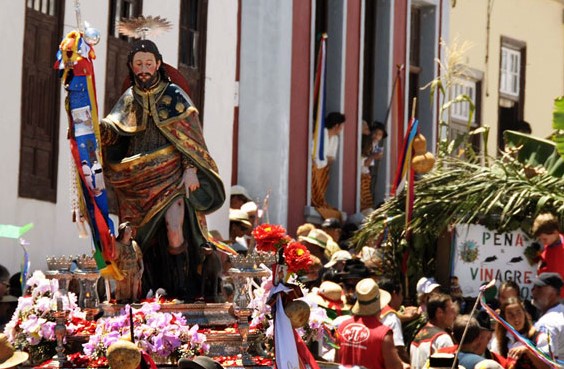
Romería de San Roque in Garachico

Romería de San Roque in Garachico

Every year thousands of visitors gather in Garachico to participate in one of the most popular and traditional festivals on the island, first held in the 17th century and described as, "Garachico’s most important annual festival when the town fills with pilgrims (and partygoers) from throughout the island. San Roque (Saint Roch), the town’s patron, was credited with saving the town from the Black Death, which arrived in 1601." As tradition marks, at 8:00 a.m. the town will wake up with the 'Viva San Roquito', thanks to the Garachico Musical Group. 

The Romería (Pilgrimage and festivities of San Roque (Garachico), which in 2006 attracted around 30,000, is held annually on 16th August (irrespective of day of the week), from around 2pm. The figure of the Saint is earlier taken from the Ermita de San Roque to the church of Santa Ana, in the town centre and after a religious service, is taken back to its hermitage, accompanied in procession by the municipal band, carts, flocks of goats and other festively bedecked animals, and musical groups (rondallas and parrandas). The fishermen of Garachico hold a sea-going procession, their boats forming part of the Saint's entourage along the coast. The traditional pilgrimage dance is held in the Plaza de San Roque.

And you probably need to try The famous Sangría of San Roque.

Friday, 31 July 2015

Garachico tyre burning fiesta 2015

Garachico tyre burning fiesta 2015

We have to thank for highlighting this event. Of course it isn't really called the Garachico tyre burning fiesta, which she coined, but we think it's a brilliantly descriptive, attention grabbing title and don't understand why that isn't yet official. Actually called the Fuegos del Risco (Cliff Face Fires), which, as is explained in this article in El Dia, Una erupción festiva cada cinco años, these have evolved from pineapples in wooden barrels through dried corncobs soaked in petrol and diesel; sackcloth balls and, yes, on occasion, burning tyres. 

They point out that a small group of people is responsible for setting the lava slopes of Garachico aglow once again at a point close to where the ancient port was located. With logistical support from the town council, they reactivate the fury of the Trevejo volcano (or Montaña Negra - Black Mountain), which destroyed the port of Garachico in 1706, with the help of fireworks and glowing balls rolling down the slope. In the dark of night, the incandescent objects falling down the hillside recreate the effect of a volcanic eruption.

It promises to be spectacular on Sunday night, 2nd August at 10pm. But get there early, because last time, in 2010, it drew a crowd of 35,000.  

What I don't understand is why this is celebrated every 5 years on the 0s and 5s, when the volcanic eruption was in 1706 - it can never fall on an anniversary - or why it takes place in August, as the eruption was in May. No doubt someone has an explanation for these seeming anomalies, but does it matter? Do you need a valid excuse to "celebrate" a disaster by rolling burning tyres down a hillside?  

It's just part of the Fiestas Lustrales y de San Roque 2015 in honour of the Santísimo Cristo de la Misericordia (Holy Christ of Mercy) and San Roque, being held from July 23rd to August 2nd (and actually on to the Romería de San Roque on August 16th, of which more later.) The origins of the fiestas date back to 1659; the first time the firework spectacular appeared under the name of the Fuegos del Risco was in 1922, although it was already celebrated in some form in 1881.

Other attractions this weekend include the Desfile De Carrozas Alegóricas (Parades of Allegorical Floats) on Saturday, 1st August at 10pm and on Sunday, 2nd August at 6pm. These are six floats, authentic works of art that require months of work. Residents of all ages work on these making hundreds of thousands of paper flowers, and elements in wood, cork or paper.

Friday, 25 August 2006

From Candelaria to San Roque ...

San Roque in Garachico

De fiesta, a fiesta ... You'd be forgiven, mainly because you'd be right, for thinking that in Tenerife there is a fiesta a week (at least) to attend. And there's certainly no lack of variety in the entertainments these events provide and plenty of people who do 'crawl' from one fiesta to the next, especially through the summer.

The fiestas in Candelaria just took place for the archipelago's Patrona, then the party moved to Garachico for fifteen days worth of fiestas in honour of San Roque, which this year drew a crowd of 30,000 to the traditional romeria alone - and that ain't a bad turn out for a town of scarcely 6,000 inhabitants.

The origin of the devotion to the saint goes back to the middle of 17th Century, when an epidemic of plague hit the island of Tenerife. The villagers in Garachico, who had been particularly affected, asked the saint to intercede and, apparently, it worked. Since then, the people of Garachico have remembered the event honouring the patron saint of the locality with a traditional romeria.

The police had never seen so many at this fiesta before. The town was completely blocked off by 11 a.m. and people had to park as far away as La Caleta. Forty-five carts went in procession behind the saint on it's route through the town, which along with good local wine, of course, potatoes and meat cooked on the barbeques on the back of the carts, kept folk amused for 5 hours.

In the meantime, La Guancha have also been celebrating their fiestas in honour of the Virgen de la Esperanza (Virgin of Hope).

This week, it is the turn of Buenavista del Norte, who celebrated a solemn mass for the town's patron, San Bartolomé, yesterday - along with an open-air rapid painting contest in the Plaza de Los Remedios. The winning entry, by Meca González, recreated the scene of the unique dance of Las Libreras - which will be part of the fiestas in El Palmar next month.

On Sunday, in Buenavista del Norte, also as part of the fiestas in honour of San Bartolomé, some 90 crafters will be taking part in the Feria de Artesanía de Buenavista del Norte (Buenavista del Norte Crafts Fair), which is also becoming one of the principal summer attractions of the Isla Baja area.

The time is given as "from the first hours of Sunday". I would translate that as about 10 a.m. ish onwards. As well as typical crafts, there will be ambulant musicians through the day and at 7 p.m. there is concert of folk music.

Also in the El Palmar valley this week, in the district of Las Portelas, are the fiestas in honour of Nuestra Señora del Carmen, from today, August 25th, until September 3rd. I have it on excellent authority - proving the rule that public washbasins are indeed news broadcasting sites, so this is breaking news here in the "media" - that there will be a salsa band from Los Realejos tonight, fireworks tomorrow and mass and a procession on Sunday afternoon.

The Las Portelas fireworks are an annual event that I "attend" from home and it's a spectacle that has to be experienced. Fireworks are always spectacular here, but these have another, entirely unique attraction: that of the acoustic effects of the valley walls. I can hardly describe it, but because the valley is a big basin, almost completely surrounded by an inverted "D" shape of sheer walls, it's like a very noisy train running around that ricochets off the Teno mountains.

And, as I hinted above, the next local fiestas and mini country-fair will be those of the village of El Palmar itself, at the back end of September, which includes the dance of Las Libreras and the annual event of La Trilla (threshing).

Before the fiestas in El Palmar, there will be fiestas up in Teno Alto. Then, in October, there will be more fiestas in Buenavista del Norte and, there are the fiestas up in Erjos to be taken into consideration.

And you can't help thinking that once this fiesta season is over, it will be only a few short weeks before the two public holidays at the beginning of December usher in the month-long Christmas season. Then, as soon as we've had Los Reyes, in January, the carnival season will commence ... and as soon as that is over, the spring-summer-autumn romerias and fiestas circuit will begin again.

We came to the conclusion that the best job in the Canary Islands has to be hot dog or sweet stall holder, because they follow every fiesta of every type! :-)

Sunday, 7 May 2006

Garachico Remembers its History

Garachico from behind the Parque Puerta de la Tierra

"A community which doesn't know its history, has no future", commented Garachico's mayor, Ramón Miranda, during his speech at Friday's inauguration ceremony for the new obelisk. On Friday, 5 May 2006, Garachico commemorated the 300th Anniversary of the eruption which had destroyed the town's port and economy and, on Monday, Miranda, who has been mayor of the town for 11 years, will celebrate his 43rd birthday. How do I know? His mum told me!

Left to right: Mayor of Garachico, Ramón Miranda; President of the Canary Islands Government, Adán Martín and Councillor for Roads and Transport, Lorenzo Dorta.

Figuring it was unlikely I'd be around to see the celebrations at the next centenary, I decided I had to go to Garachico on Friday afternoon. As there were to be scenes taking place in the port, the car park there was closed. The other car park, at the football ground, was marked for coaches only and, after a round of all the back streets, I was nearly ready to give up, when someone left and I grabbed the space they vacated between the park and the sea front. It was a gift and situated right by the park where the events  were about to begin.

It was already past six p.m., but on my way to go to the obelisk for the inauguration, I'd seen Doña Lola standing outside her restaurant, Casa Ramón, on the Calle Esteban de Ponte. As I've eaten there regularly for many years, we're on chatting terms, so I stopped to say hello. Not that I needed to worry, because late is normal here and, even after I had climbed the steep hill behind the Parque Puerta de la Tierra to where the obelisk has been placed, there was still only the local TV and press in attendance. Plenty of time to take photos and have a chat to the camera man, while we waited for the suits to arrive.

The President gets waylaid for a chat before proceedings commence. Former mayor of Arona, now councillor for Cultural Affairs of the Tenerife Cabildo (Corporation), Miguel Delgado (on the right).

Also amongst the party of dignitaries and their entourage was former mayor of Arona, now councillor for Cultural Affairs of the Tenerife Cabildo (Corporation), Miguel Delgado. It is possible that from my days working for the local press that, if he has a really good memory, he might know my face, however, I was still surprised that he said hello to me. The President smiled at me (I expect he smiles at everyone) and Ramón Miranda nodded, which is no surprise, since we've coincided at numerous events in the town before.

There was not a particularly huge crowd; a few locals, maybe half a dozen Germans (tourists, from their attire), but considering how much English pirates and merchants had to do with the growth of Garachico back in its early days, a blinking disgrace that I appeared to be Britain's one and only representative.

A classic obelisk, before the unveiling. The detail shows the symbol of a phoenix rising from it's ashes. The real surprise comes after dark.

What was said in the inaugural speeches, was pretty obvious stuff, but I am glad I'd been there, because now the obelisk means something more to me than a mere pointy thing on a cliff side. I also made a point of having a few words with its designer as the party made its way down to the next event in the Plaza.

Dignitaries line up for the presentation of a sand carpet, made by alfombristas from La Orotava.

Next was the presentation of a sand carpet outside the Casa de la Piedra (former mansion of the Counts of La Gomera), with the saint, San Roque, whose worship is celebrating its fourth centenary and a scene depicting the eruption.

The Mayor of La Orotava, who had been hired as the comedy turn, I think, spent some time proudly recounting his recent visit to San Antonio, Texas. It has been much criticized that 140 kilos of Teide soil had been transported across the pond for that particular event, but one thing I did learn from this speech is why. Yes, they do also have coloured sands in the United States. What they did was to mix the two as a symbolic mixing of the people from the Canary Islands and the United States. Considering how immigration is constantly making headlines in both locations, this symbolic act now looks well timed.

Isaac Valencia Domínguez, La Orotava's Mayor, was explaining how the sand carpets, which are an annual feature for Corpus Cristi, are made to be walked on. Ramón Miranda took the microphone at the end of the discourse to say, "Don't even think of walking on the carpet!" It was to remain in place over the weekend so that more people could see it and he didn't want anyone walking on it until Monday. As soon as we all moved on to the next act, I notice that barriers were quickly placed around it, with police hovering nearby.

Inside the former Convent of San Fransisco, Juan Carlos Carracedo, Scientist in charge of the Volcanological Station of the Canary Islands, in La Laguna, Tenerife, takes another opportunity to assure us that there is no need to panic about volcanoes.

The next part in the proceedings was what I had been looking forward to - the opening of the exhibition in the former convent. Questions that have been circling in my head for years have revolved around, where did the lava go, how big was Garachico's port before it was filled in, which bits of land weren't there before the eruption and, indeed, which buildings in the town had existed before or were built after. I didn't quite get all of the last question answered, yet.

Route of the two lava flows of the 1706 volcanic eruption in Garahico.

The image shows the two major lava flows that affected the town. The green one, at 9 p.m. on May 5th, 1706 was the one which filled in the port. You can see from the dotted blue line shown on this image of a modern aerial photo, overlaid with the paths of the 1706 lava flows, where the limits of the former deep water port had been. Just to the left edge of that blue dotted line is a square dark green patch: that's the Parque Puerta de la Tierra, a park that is now inland, that had been at the water's edge before the eruption. Puerta de la Tierra literally means "Door or gate to the land" - in this case, the gate from sea to port through which all people and goods formerly had to pass. You can also clearly see the pretty large piece of land outside of that dotted blue line, marked "Antiguo Puerto" - meaning Old Port, which now houses about four streets in either direction, another plaza in the middle of those streets and all of the jetty and current port of Garachico, all built on land that, before the 1706 eruption, had not existed.

The second lava flow, in yellow, which occurred at 8 a.m. on May 13th, 1706, came right into the town, but (miraculously) skirted around the former convent where were were standing. (Circled and labelled "ESTA AQUI" (You Are Here))

Several of us were doing the same thing: comparing maps to photos to our own knowledge of the town, retracing the blue dotted line on photos with our fingers and exclaiming in similarly coloured words about the extent of the difference. 

There was also a conference, entitled, "Garachico The Eruption of 1706", starting at 8 p.m., I thought it was going to be a bit heavy going after an already long day and decided to skip that and headed for the kiosk in the Plaza de la Libertad for a coffee before setting off home. However, on the way back to the car, I spotted Doña Lola, still standing at the door outside her restaurant and we ended up chatting, about this and that, for another hour or so.

Restaurante Casa Ramón, Calle Esteban De Ponte, Garachico

Various people came and went asking if the kitchen was open (there is definitely a lack of eating places open in the evening here) and a couple more, known to her, whom she was happy to serve with a glass of wine and tapas of fresh goat cheese. During this time too, the streets began to fill with life; a melee of spectators as well as actors and extras in all kinds of historical costume; the street theatre, with Punch and Judy style puppets arrived in the Plaza de Juan Gonzalez de la Torre and dusk befell, which afforded us a grand view of the obelisk's secret. It isn't stone, it's fibreglass and it throbs. Er, it lights up from inside and pulsates with a red glow at night, symbolizing the volcanic eruption. Or a huge erection. And Doña Lola's giggles told me I was not the only one to think it!

Knowing I'd been to the inauguration and presentation, Doña Lola was asking me who (of the dignitaries) had been present. As I began rattling off the names, she asked, "You do know that Ramón Miranda is my son?" I didn't. I do now. LOL!

Energy flagging, I didn't stay for the fireworks or the rest of the theatre. Some of these events required invitations, which I did not have and numbers of spectators were already showing themselves to be much higher than anyone had expected. Some 5,000 people (not bad for a town of around 6,000), were there to watch events, according to the local police. Then in the early hours of Saturday morning, it was reported, the most inopportune shower in the last 300 years threatened to put out the fires of the man-made, simulated eruption. As El Día reported the next day, "Three centuries later, the rain appeared without warning, perhaps because it had a debt owing to the town it was unable to help in 1706."

Thursday, 4 May 2006

Theatre, Music and Fire to Commemorate the 1706 Volcanic Eruption in Garachico

Garachico's Puerta de la Tierra (literally, Door to the Land). This stone structure was designed to control passengers and goods that came in and out of the port. It dates back to the very origins of the Port of Garachico itself." [Ref] It now stands in the Puerta de Tierra park that is behind the Plaza de Juan Gonzalez de la Torre, and a very good distance back from the water's edge.

It's a year of commemorations in Garachico. The town has just celebrated the 400th Anniversary of worship of San Roque. "Worship of this saint is related to the general jubilation of the local population at recovering from an outbreak of bubonic plague, in 1606, that had ravaged the town of Garachico for five years." Now, is the turn of the third centenary of the Eruption of Trevejo (1706), on May 5th, 1706, that put an end to the commercial activity of the ancient port.

At 18:00 on Friday, an obelisk is to be inaugurated in the Puerta de la Tierra park to commemorate the eruption of the Trevejo volcano 300 hundred years ago and which will be the beginning of a program that will move on to the square, Glorieta de San Francisco at 18:45 for the presentation of a sand carpet made by alfombristas from La Orotava. Afterwards, at 19:15, in the Mencey Romén hall of the former Convent of San Fransisco, an exhibition, 'Volcanes en el Oceáno' (Volcanoes in the Ocean), under the auspices of Juan Carlos Carracedo, Scientist in charge of the Volcanological Station of the Canary Islands, in La Laguna, Tenerife, with aid from the La Caixa foundation.

The main dish of the celebrations is 'Palabras de Fuego y Agua' (Words of Fire and Water), a show of theatre, fireworks and music, directed by Ernesto Rodríguez Abad, with collaboration from the school of music and folklore groups from the area. The show, with a cast and crew of 80 people, starts at 22:00 and aims to recreate the volcanic eruption from elements that are between legend and reality, offering a passage back to Garachico of another era.

Various parts of the town have been decorated as a prelude to thse events, culminating in the port and esplanade with Entre el Fuego y el Mar (Between the Fire and the Sea). Without giving us more details, they say that during the night, the slopes above the town will "once again burn", just as they had done in 1706.

However, the program of acts for the two centenaries go much further than Friday's events. Amongst others, there will be the congress on volcanology, "Garavolcán 2006", between May 22 - 26; the transfer of the image of San Roque, on August 27, from the Church of Santa Ana, back to its hermitage where a monolith is to be inaugurated to commemorate the fourth centenary of its worship and a congress on "Natural Catastrophes and Society" from the 16th to 19th October. Between the 4th and the 8th of December, the town and port will be the seat of a congress, ’¿Qué es la alegría?’ (What is Joy?)